Gold, silver and platinum in the middle of an energy crisis: the good and the bad for each metal
How the war, diesel, stockpiles and interest rates are affecting gold, silver and platinum. What is working for and against each metal.
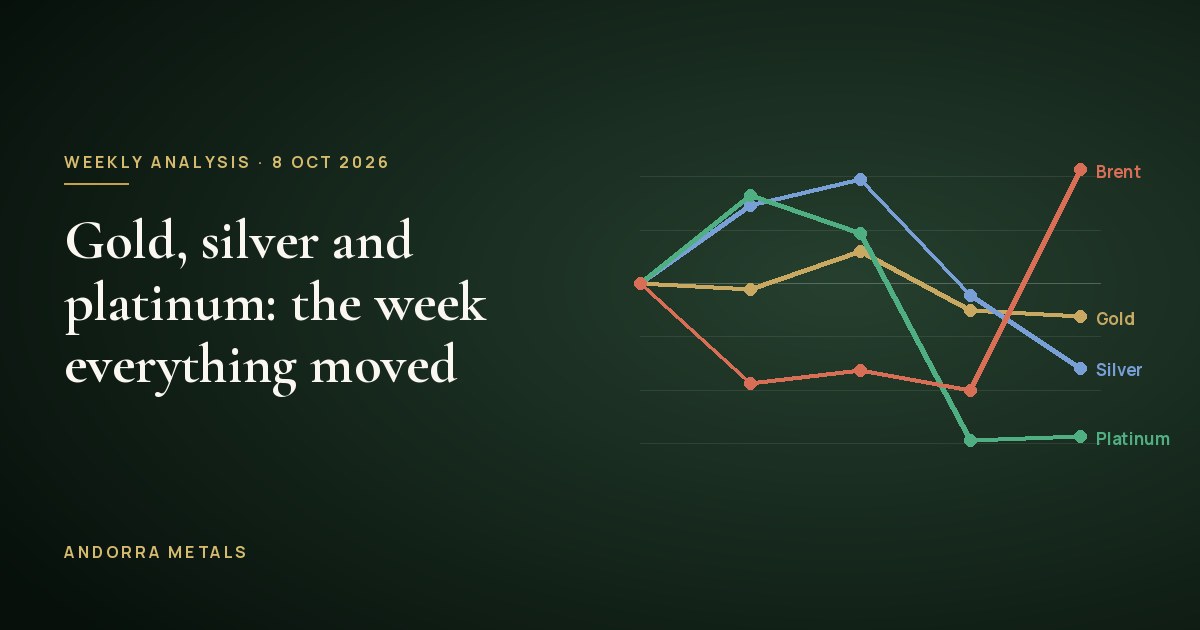
September was a tough month for precious metals: gold closed down 8.5% and silver down 13.5%. If you hold physical gold or silver, or are thinking of buying, it is natural to wonder what is going on.
The short answer: metals are not falling because they have lost their appeal, but because of the effect of interest rates. In this article I explain, without jargon, what is working for and against each metal.
The background in a nutshell
It all starts in the Strait of Hormuz. The blockade has pushed up energy prices, and although Gulf crude is already flowing through alternative routes, diesel has not recovered: refined products passing through Hormuz are still 81% below normal.
A tanker sets sail as soon as the route is safe; a damaged refinery takes months to come back. That is why diesel is today's real bottleneck.
The chain is simple:
- The war makes oil, and above all diesel, more expensive.
- Expensive diesel pushes up transport, food and, in the end, inflation.
- With high inflation, the Federal Reserve holds or raises interest rates.
- With high rates, a bond paying 5% competes with gold, which pays no interest.
That is why metals suffer in the short term. But the same chain has a second part worth remembering: with US public debt of more than $40 trillion, keeping rates high for a long time is very expensive. In the medium term, central banks usually end up tolerating more inflation, and that has historically been a favourable environment for real assets.
The first chain explains September's fall; the second explains why the underlying fundamentals have not changed.
Geopolitics: how long can the blockade last?
The conflict reaches its 215th day today with no clear way out. On 26 September the United States rejected Iran's offer to reopen Hormuz within seven days and, according to the Wall Street Journal, Trump is considering resuming air strikes after the 3 November elections if there is no deal.
At the same time, diplomacy has been revived. Iran confirms it has received a US proposal to reopen the strait, and the talks, mediated by Qatar, are picking up June's plan. The problem is that neither side will give ground on the essentials: Washington rules out sanctions relief and Tehran rules out any nuclear flexibility.
Why Washington is in no hurry. The blockade has left Iran with no crude exports (zero in September, according to satellite data), while the rest of the Gulf has already recovered its volumes. The economic pressure falls on Tehran.
The other front: the Red Sea. The Houthis control the Yemeni coast, have declared Bab el-Mandeb closed to Saudi traffic and have attacked Yanbu, Taif and Riyadh. That threatens precisely the alternative routes crude is using today.
Our scenario map suggests the restriction will remain at least until the end of the year, in line with the IEA, which assumes Hormuz stays restricted throughout 2026. The 3 November elections are the turning point.
What would change our mind. We would move to a resolution scenario if war-risk insurance premiums normalised and the major shipping lines went back to crossing Hormuz on a sustained basis. Neither signal is present today.
Oil: crude has found another way
The most important figure of the month is that Gulf crude, excluding Iran, is already back to its pre-war level: around 16.5 million barrels a day in September, according to Kpler. JPMorgan puts it at 98%.
But it is arriving through a very different system:
- 40% of crude no longer passes through Hormuz (up from 17% before). It leaves through pipelines to the Gulf of Oman and the Red Sea.
- More than 70% of what does cross the strait is transferred between ships at sea.
- Many tankers sail with a military escort or with their transponders switched off.
It is a system that works, but it is expensive and fragile. And refined products have not recovered: the region's refineries are processing 7.3 million barrels a day compared with 9.9 in February, and the International Energy Agency (IEA) does not expect a full recovery until 2027.
Stockpiles: the cushion is running down
Since February the world has consumed around 3 million barrels a day more than it produced, and has covered the gap by drawing down stocks. According to the IEA, global inventories have fallen by 507 million barrels, 95 million in August alone.
Strategic reserves, the last cushion, are at multi-decade lows:
- OECD government stocks are at their lowest level since 1990.
- The US Strategic Petroleum Reserve holds 285 million barrels, the lowest since 1982. Even so, Washington has authorised a new loan of up to 40 million barrels to companies.
- In Europe, gasoil stored at the Amsterdam-Rotterdam-Antwerp hub hit a four-year low at the end of August.
- France has called a G7 meeting to consider a second coordinated release of stocks.
With Gulf crude already back, the drain on crude stocks should ease in the coming months. The drain on distillates, however, will not.
Diesel: the real bottleneck
If one product sums up this crisis, it is diesel. Refined products passing through Hormuz have fallen by 81%, and pump prices across Europe already reflect it.
The war on Russian refineries. Ukraine has made Russian refineries its main target: around twenty attacked in three months and close to a quarter of Russia's refining capacity out of action. In September it hit the Moscow refinery, which supplies 40% of the capital's fuel. Russia, the world's second-largest diesel exporter, has extended its diesel export ban until 31 October.
Other brakes on supply. Aramco has not allocated any Saudi crude to Europe for October, and in the US a ban on diesel exports has even been floated. Goldman Sachs has doubled its forecast for diesel margins in 2027.
Rationing under way. The IEA counts around 40 countries that have moved from asking for savings to imposing mandatory measures. Pakistan has halved fuel for official vehicles, Sri Lanka hands out weekly quotas by QR code and, within the EU, Slovenia and Slovakia are already rationing or limiting diesel purchases.
Europe is adjusting through price: fuel sales in France are down 5.5%. Asia, with small stockpiles, is adjusting through physical rationing. The first can hold out for months at the cost of growth; the second, much less.
How long have we got? The European winter
The weak spot is Europe in winter. Today it has around 50 days of diesel cover, against a critical threshold of 23, and uses up 4 to 6 days of that cushion a month. If refined-product supply is not replenished, the numbers lead to a risk zone between February and April 2027.
That window coincides with the point at which gas storage will be emptiest: Germany starts the winter at 57%. In addition, NOAA puts the probability of a "very strong" El Niño at over 90%, which may soften the start of winter but increases the risk of a late cold snap in exactly those weeks.
This is not a countdown to collapse. It is the window in which prices would have to rise enough to curb consumption, or governments would have to ration. Either way, the effect is direct: more inflation just when central banks were hoping to see it fall.
From diesel to inflation: the two waves
Diesel powers lorries, tractors and heating. That is why its rising cost does not stop at the petrol station: it reaches inflation in two waves.
- First wave (0-3 months): what we pay for fuel and electricity goes up. It is direct and shows up straight away.
- Second wave (3-9 months): transport, food and services go up. This is the dangerous one, because it feeds into core inflation, the measure central banks worry about most.
As a rough rule, a 20% rise in oil adds just over one point to inflation within a quarter and around four tenths more in the following months.
This is the key for the coming months. The August figure was encouraging, but US producer prices are up 5.4%: pressure that has not yet reached consumers. If diesel stays expensive through the winter, the second wave could halt the fall in inflation just as the market is starting to count on it.
Gold
Gold is trading around 25% below its January record. It is the most stable of the three metals, but also the most sensitive to interest rates.
The good
- Central banks are still buying: China has been adding gold to its reserves for 22 consecutive months.
- Inflation is starting to ease. August's PCE, the Fed's preferred measure, came in better than expected. If confirmed, the pressure on rates will ease.
- The underlying problem, public debt, has not gone away. It is exactly the kind of risk gold has been a refuge from for centuries.
The bad
- The 10-year US Treasury yield has risen above 5%. As long as bonds pay that much, gold has a strong competitor.
- The US economy is growing faster than expected (2.2% in the second quarter), giving the Fed room not to cut rates.
- September's inflation data will still include record diesel prices, so volatility may continue for a few weeks.
The closer these bars get to the 2% line, the more room the Fed will have to cut rates, and that usually works in gold's favour.
Silver
Silver is trading at roughly half its January record. It is gold's nervy sibling: it falls further in bad phases and, historically, rises further in good ones.
The good
- It has been in deficit for six years in a row: the world consumes more silver than it produces, according to the Silver Institute.
- Between 70% and 74% of silver comes as a by-product of mines for other metals. That is why supply cannot react quickly even when the price rises.
- The war is also hitting supply: a shortage of sulphuric acid is hampering copper mining, and with it the silver produced as a by-product.
- India has restricted imports of bars and raised the tariff from 6% to 15%, which is tightening the physical market.
The bad
- It has a strong industrial component. If the energy crisis slows the economy, demand from factories suffers.
- Its volatility is high: moves of 10% or more in a month are not unusual and can test your nerves.
Platinum
Platinum is the forgotten precious metal, but its market is small and very tight.
The good
- The World Platinum Investment Council expects the second half of 2026 to return to deficit.
- Above-ground stocks cover less than three months of demand: any supply strain is felt quickly.
The bad
- Like silver, it depends heavily on industry, especially the car industry. A slower economy weighs on it.
- Selling by investment funds has pushed 2026 as a whole into a slight surplus, which has held the price back this year.
What to watch in the coming weeks
| Date | What happens | Why it matters for metals |
|---|---|---|
| 27-28 October | Federal Reserve meeting | It sets the course for interest rates, the factor that weighs most right now |
| 31 October | End of Russia's diesel export ban | If extended, diesel will stay expensive in Europe |
| 3 November | US elections | Turning point for negotiations with Iran over Hormuz |
| Winter | Gas and diesel levels in Europe | Germany starts the winter with its gas storage at 57% |
In short
In the short term, high interest rates weigh on all three metals. In the medium term, the fundamentals are still there: central banks buying gold, a silver deficit and a very tight platinum market. What matters is telling a correction apart from a change of cycle, and what we are seeing today looks more like the former.
- Central banks buying
- Inflation starting to ease
- A hedge against debt
- Bonds at 5%: tough competition
- Strong economy: high rates
- Six straight years of deficit
- Rigid supply (by-product)
- Restrictions in India
- Depends on industry
- High volatility
- Deficit in the second half
- Stocks cover under 3 months
- Closely tied to the car industry
- Fund selling in 2026
If you would like to talk about physical metals calmly, Andorra Metals will see you by appointment in Escaldes-Engordany. We will explain your options in gold, silver and platinum, with no rush and no obligation.