The real de a ocho: the silver coin that connected the world before the dollar
History of the real de a ocho, the silver coin struck in Mexico and Potosí that circulated between the Americas, Europe and Asia: pillar dollars, Chinese chopmarks, the Manila Galleon and the origin of the dollar.
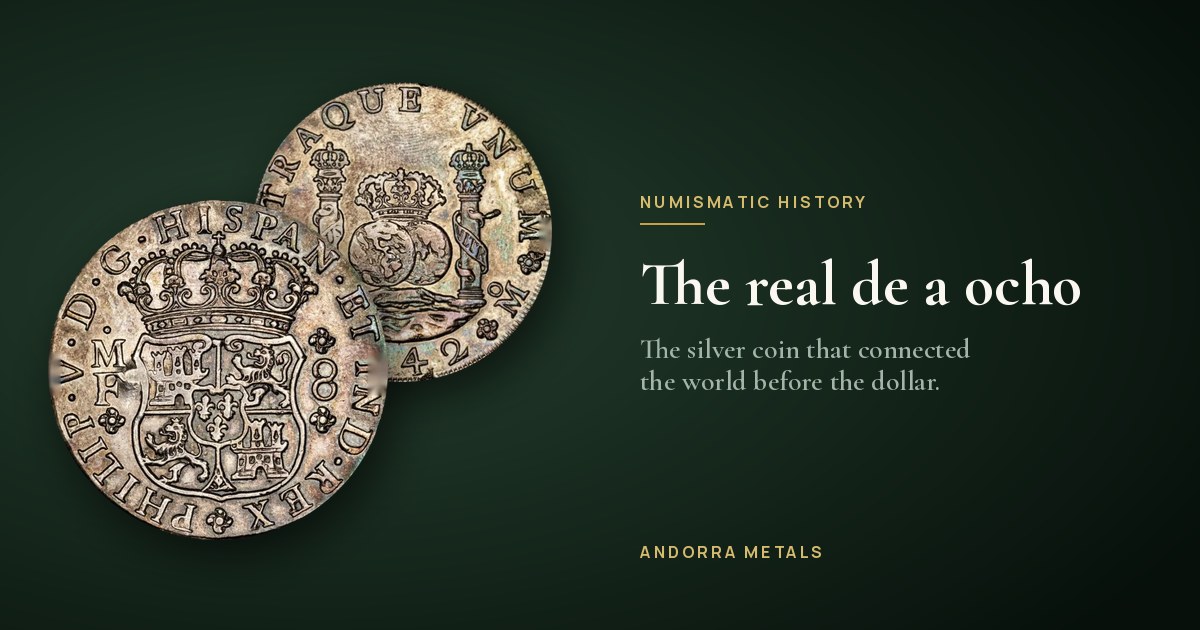
Long before the US dollar became the benchmark of international trade, a coin struck in the territories of the Spanish Monarchy circulated between the Americas, Europe and Asia: the real de a ocho. It is also known as the eight-real piece, peso of eight reales, Spanish peso, Spanish dollar or piece of eight. It made it possible to pay for goods, accumulate wealth and settle debts between societies that shared no language, institutions or monetary system.
Its history brings together mining, imperial expansion, navigation, trade and trust. It also explains part of the origin of the US dollar and the long influence of Mexican silver on Asian markets.
It is often described as the first truly global currency. The phrase is reasonable given its transcontinental reach, but it should not be confused with a modern reserve currency: its acceptance rested above all on the silver it contained and on the reputation of its issues.
From monetary reform to American silver
The foundations of the system that produced the real de a ocho lie in the Catholic Monarchs' reform of 1497, the Pragmatic of Medina del Campo. Its international expansion, however, came mainly from the 16th century onwards, driven by the enormous output of American silver.
The Mexico City Mint, founded in 1535, became one of its great production centres. Other mints in the Americas joined it, Potosí foremost among them.
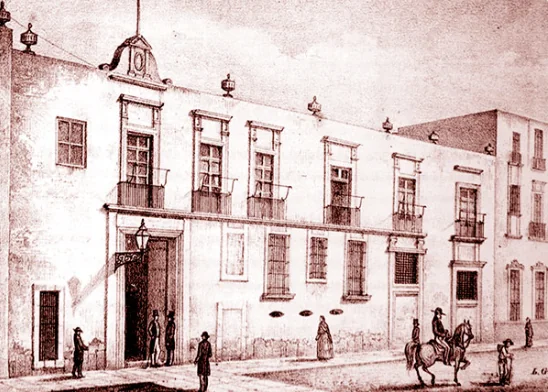
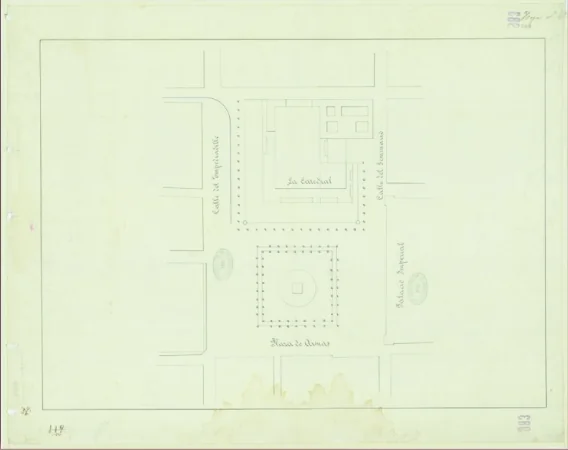
The first coins came out in 1536. The mint first occupied the site of today's Nacional Monte de Piedad and, after a brief spell on the corner where the Mexico City Government building now stands, moved in 1569 to the Viceregal Palace, today's National Palace, where it gave its name to Calle de Moneda. It operated there until 1848; its old building now houses the National Museum of World Cultures. After independence, the mint was renamed the Imperial Casa de Moneda de México and later the Casa Nacional de Moneda. According to the institution itself, it was the first mint on the continent and the first public institution in New Spain.
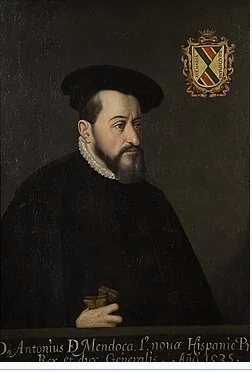
The royal decree (cédula) of 11 May 1535, addressed to Viceroy Antonio de Mendoza, set its first rules. It prohibited the striking of gold for the time being and provided only for minor pieces: single reales, two- and three-real pieces, half reales and cuartillos. The real de a ocho would come later, authorised by a decree of November 1537. Curiously, the coin was born with restricted exports: it could only leave for Castile and the Indies, at 34 maravedís per real, and taking it elsewhere was punishable.
A second decree, dated 31 May 1535, reveals the problem the mint was meant to solve. As there was no gold or silver coinage in New Spain, reales brought from Castile circulated at 44 maravedís, because of the risk and cost of transport, compared with the 34 they were worth in Spain: a premium of close to 30%. The Crown ordered that, two months after the decree was proclaimed, no real could be worth more than 34 maravedís, the same price as those struck in Mexico. It is a good example of how a shortage of means of payment made money more expensive, and of how a local mint eliminated that premium.
The decisive step came with the decree signed by Charles I at Monzón on 18 November 1537. Mendoza had reported that the mint was striking four-real, two-real, single and half reales, but not three-real pieces: they looked too much like the others and debtors could slip them into their payments. He added that people were asking for eight-real pieces because they were "the exact count of one peso". The king approved this approach and authorised the real de a ocho, while leaving the decision to the viceroy, "if it seems to you advisable". The coin that would conquer the world was therefore born of a practical demand: to match the unit of account already in use, the peso. The same decree extended by two more years the service of the indigenous workers at the mint.
Silver was not enough for small payments. On 28 June 1542, according to the account of that decision that has come down to us, Viceroy Mendoza ordered 12,000 marks of billon to be struck "without the fineness of coinage", in other words practically copper, in pieces of 4 and 2 maravedís: 36 of the large ones per mark and twice as many of the small ones. They bore the same iconography as the silver: the column with the plus ultra and the crown, the castle, the lion, the K for Carolus and the M for Mexico. This small change was worth its value by decree, not by its metal, and shows that the same mint that struck full-value silver coins also issued fiat money for petty trade.
The discovery of the Cerro Rico of Potosí in 1545, in present-day Bolivia, and the development of New Spain mining districts such as Zacatecas and Taxco transformed the supply of precious metals. The silver extracted could be turned into coin and enter trade circuits of unprecedented scale.
The name describes its value: one real de a ocho was worth eight reales. That is also where the English piece of eight comes from.
This monetary history had a deeply unequal side. Production depended on the labour of indigenous people, wage workers and, in certain places and periods, enslaved people. In the Andes, the colonial mita imposed forced labour on indigenous communities, and the use of mercury to process the ore added serious health and environmental hazards.
The coin that facilitated trade on a global scale was also the product of a colonial system of extraction and coercion.
Why a Spanish coin was accepted so far from Spain
The success of the real de a ocho rested on three elements: recognisable metal content, abundance and accumulated commercial acceptance.
Its theoretical weight was around 27.47 grams, although it was not pure silver. Until 1728 the official fineness was 11 dineros and 4 granos, about 93% silver. That year an ordinance of Philip V lowered it to 11 dineros, about 91.7%, and lightened the piece to about 27.06 grams; from 1772 a secret order lowered it again, to 10 dineros and 20½ granos (about 90.4%), and in the 19th century the Mexican 8 Reales were around 90.3%. It is not accurate to attribute an unchanging weight and purity to every piece over three centuries.
What mattered was that merchants and money changers knew the issues and could check their quality. Where many coins were valued for their metal, that predictability was an advantage.
It did not eliminate every risk: there were counterfeits, wear, clipping and fluctuations in the price of silver. But a widely recognised coin reduced the uncertainty and cost of negotiating each payment.
On top of that came scale. American production supplied enough coin to feed very extensive trade networks, and its acceptance reinforced itself: the more merchants accepted it, the more useful it was to everyone else. This is what we now call a network effect.
From macuquinas to columnarios
The first American reales de a ocho were hammer-struck. These pieces, the macuquinas (cobs), had irregular shapes and often incomplete designs. Irregularity did not mean they were fake, but it made it hard to tell whether they had lost metal through clipping.
The remedy came through legislation. The ordinance signed in Madrid on 9 June 1728 acknowledged that the mints of Spain and the Indies had struck coin "with some carelessness" in fineness, weight and design, and that the American pieces, without a round shape or a milled edge, were "very prone to clipping and counterfeiting". It ordered coins to be struck by machine, in mills driven by water or animals, with a circular shape and a milled or laurel edge, and the same dies to be sent to every mint so that the pieces would be identical. It set the standard at 68 reales per mark instead of 67, to pay for more expensive manufacturing, and required assayers to mark the bars they assayed with their name. Lowering the fineness to 11 dineros was intended to match that of France and other neighbouring states, so that Spanish silver would be "less coveted" and not leave the kingdom. And the ordinance itself explains why exact weight mattered so much: in trade, anyone, "however little intelligent", weighed the coin on receiving it.
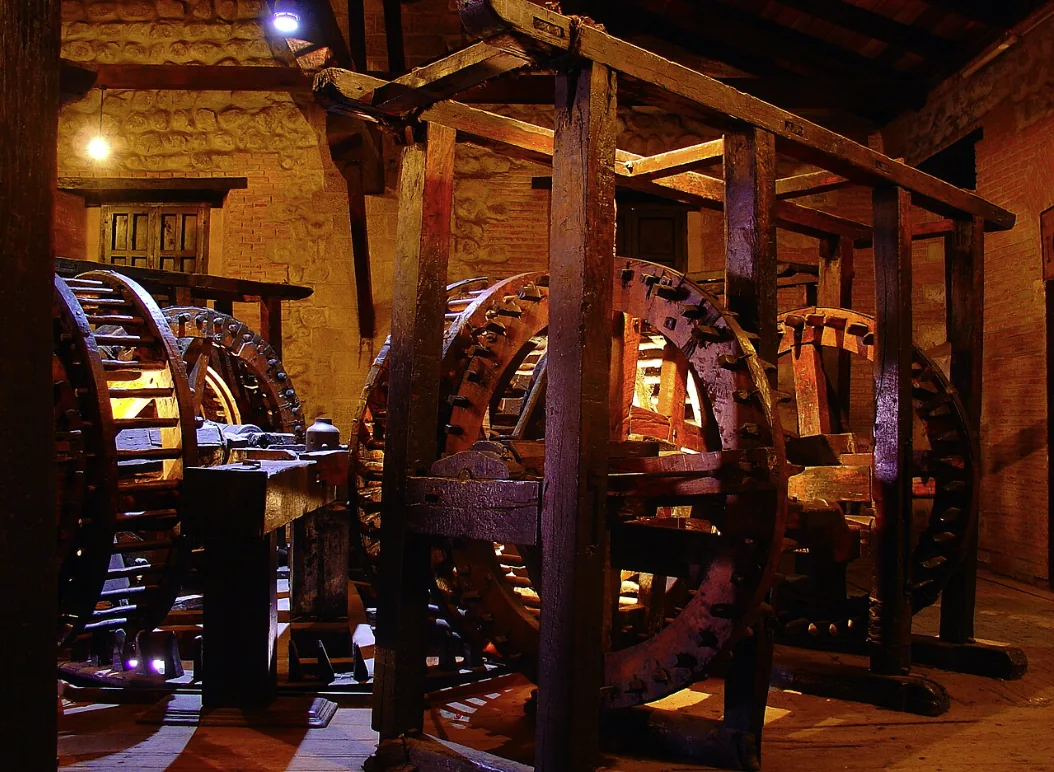
Two years later, the Ordinances of Cazalla, signed on 16 July 1730 for the peninsular mints of Madrid and Seville, took the reform further. All coining passed to the account of the Royal Treasury rather than private individuals, as had been the case until then. Each piece was to be struck individually on a screw press, with a laurel or milled edge "to avoid any danger of clipping". The fineness was fixed without "the slightest dispensation", and gold and silver were tied by law at a ratio of 1 to 16. Tolerances were measured in grains: up to four grains' difference on the real de a ocho, and pieces outside the margin were remelted at the expense of the mint official. At 68 reales per mark, the eight-real piece weighed about 27.06 grams.
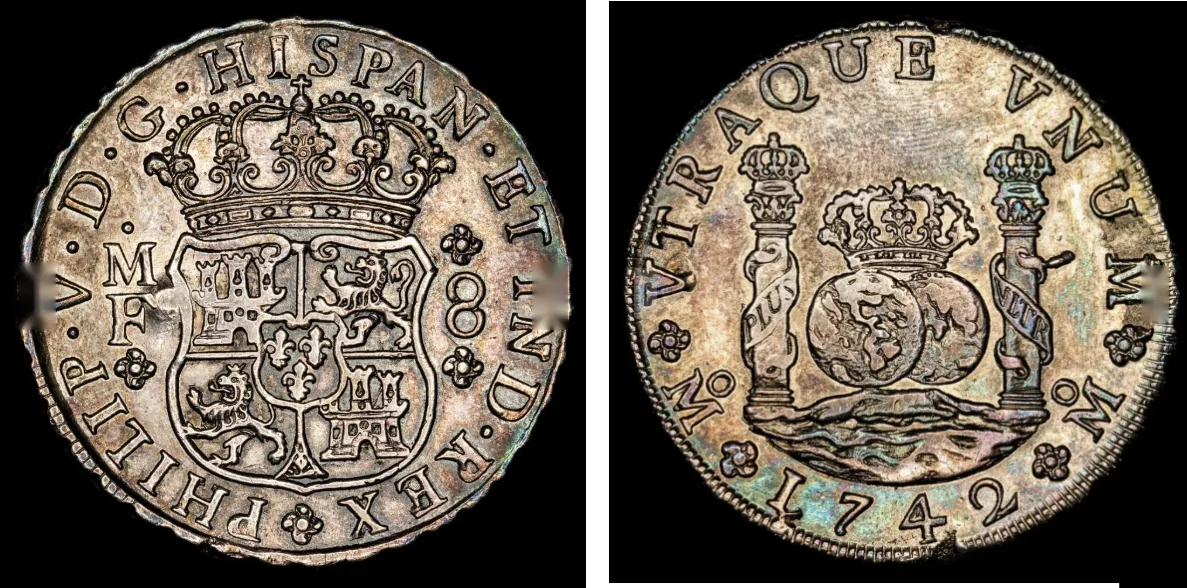
Mechanisation brought uniformity. At the Mexico City Mint, 1732 marked the start of the famous columnarios (pillar dollars): regular coins with a recognisable design and an edge that helped detect tampering. They showed the Pillars of Hercules, the motto "Plus Ultra" and two crowned hemispheres above the waves, under the legend VTRAQUE VNUM ("both are one"), an allusion to the union of the Old and New Worlds. Later came the types with the monarch's portrait, the bust coins.
A proclamation (bando) by Viceroy Juan de Acuña, Marquis of Casafuerte, dated Mexico City, 23 December 1732, documents that start. According to the superintendent of the Mint, more than 200,000 pesos of the "new circular coinage with a milled or laurel edge" had already been struck in November and December. The viceroy ordered everyone to accept and pay the new coin in their contracts at the same value as the old one, as it was "of equal fineness and weight", under the penalties applicable to anyone who refused the king's coin. That a legal threat was needed to get people to accept a better-made coin is a reminder that trust in a new format is not automatic: the same problem would reappear in 1873 with the "Balanza" peso.
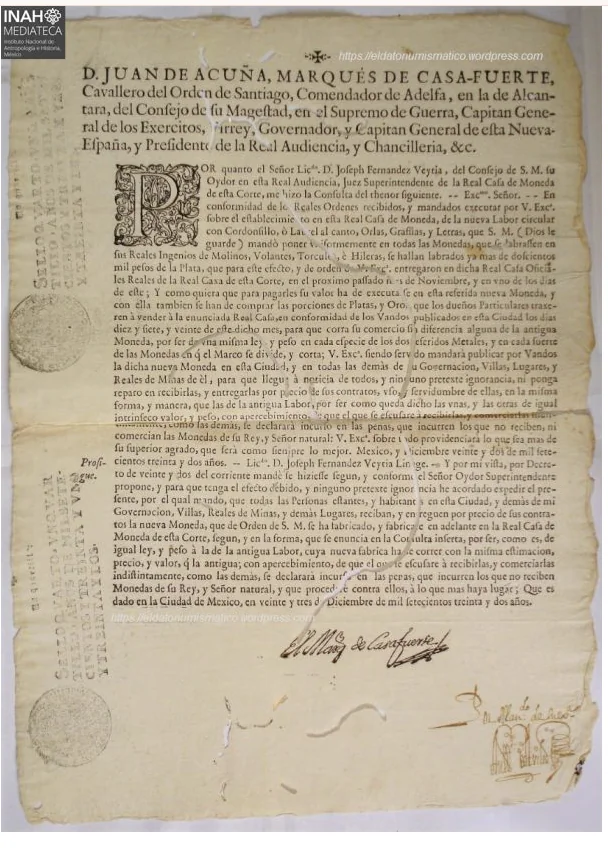
The first pieces of 1732 and 1733 have a history of their own. According to the numismatist Ernesto G. Guinea, cited by Javier Varela, they were "quasi-patterns": they were used to test the machinery that had arrived from Spain while circulation continued to rely on cobs, and most surviving examples come from the wreck of the ship Hollandia. This contrasts with the more than 200,000 pesos that, according to the proclamation, had already been struck by the end of 1732; the scarcity of examples today suggests that much of it did not survive. Some 1733 pieces carry the MX mintmark instead of the usual Mo: according to Jorge A. Proctor, the dies arrived from Spain with the wrong mark and had to be used anyway. That Mo mark, a small o above the M, is still alive: today it is the logo of the Mexican Mint. That same year, the Mexico City Mint, which had operated for two centuries as a concession to private individuals, was incorporated into the Royal Treasury. The columnarios, with a theoretical weight of 27.064 grams and a fineness of 916.667 thousandths, were struck only at American mints (Mexico, Lima, Santiago, Potosí, Guatemala and Nuevo Reino) until they were replaced by the bust coinage in 1772.
That iconography was not new. The founding decree of 1535 already ordered the two columns with the inscription plus ultra, the emperor's motto, to be engraved on Mexican coins, together with an M identifying their origin in Mexico. What changed in 1732 was the technique and the composition, not the motto.
Not all reales de a ocho carried the same design or were made with the same technique. And quality was not always impeccable: the scandal at the Potosí mint in the 17th century shows that monetary reputation could also deteriorate.
Reputation could also be eroded quietly. By a royal decree signed at El Pardo on 18 March 1771, Charles III ordered that all new silver struck in Mexico from 1 January 1772, now bearing the king's bust, be minted at 10 dineros and 20½ granos, about 90.4%, without changing the weight or the number of pieces per mark. The justification was that the coins of the foreign nations with which Spain traded most actually had a lower fineness than their ordinances declared. But the reduction had to be secret: the public was to go on believing that the coin kept its old fineness, and the superintendent, the accountant and the assayers of the Mint had to swear to keep the secret on pain of losing their posts. The decree also asked that the old, finer coin not be actively withdrawn, so as not to provoke "a rapid extraction" of it; it was enough that, after a period, it should be worth only its metal. It is a textbook example of why money changers in Asia assayed every piece: the issuer's guarantee did not always match the metal.
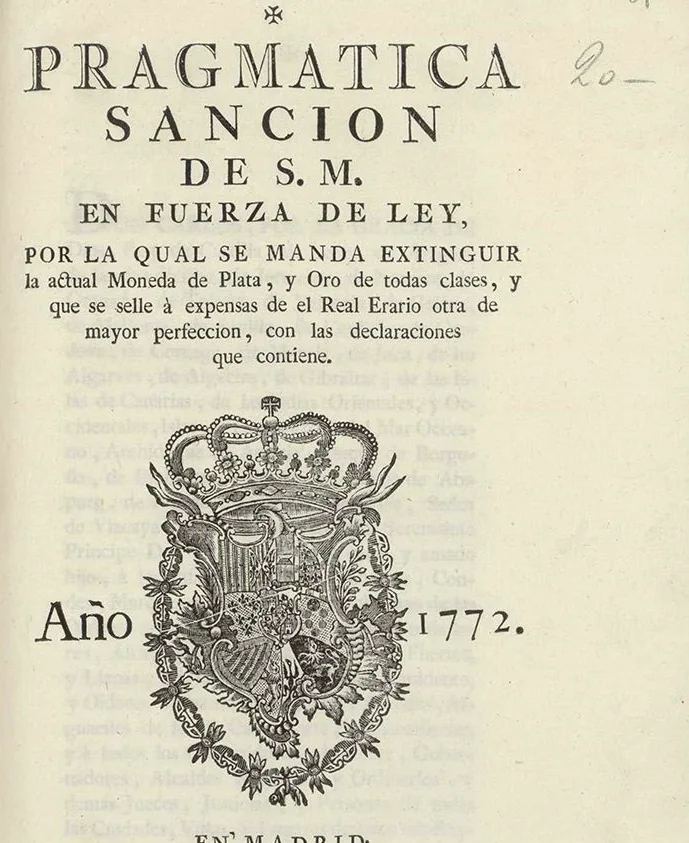
Fourteen months later, the public pragmatic signed at Aranjuez on 29 May 1772 presented the reform in different language. It justified the new coinage by the counterfeiting and clipping made easier by the "irregular shape" of the old one, and by the losses and "common distrust" caused by having to weigh every payment. It set the design of the silver of the Indies: the king's bust "dressed in the heroic manner, with chlamys and laurel" on the obverse and, on the reverse, the crowned shield between the two columns with the motto Plus Ultra. It ordered the withdrawal of the scales used to weigh coins, since a perfectly circular piece would no longer need them, while keeping official weights in the district capitals for doubtful cases. And in its Article V it declared that all coinage would be "of the established fineness and weight", because the measure sought only "to bring to the greatest perfection" the existing coins. Read together, the secret decree and the public pragmatic show the gap that could exist between what the issuer proclaimed and what it actually minted.
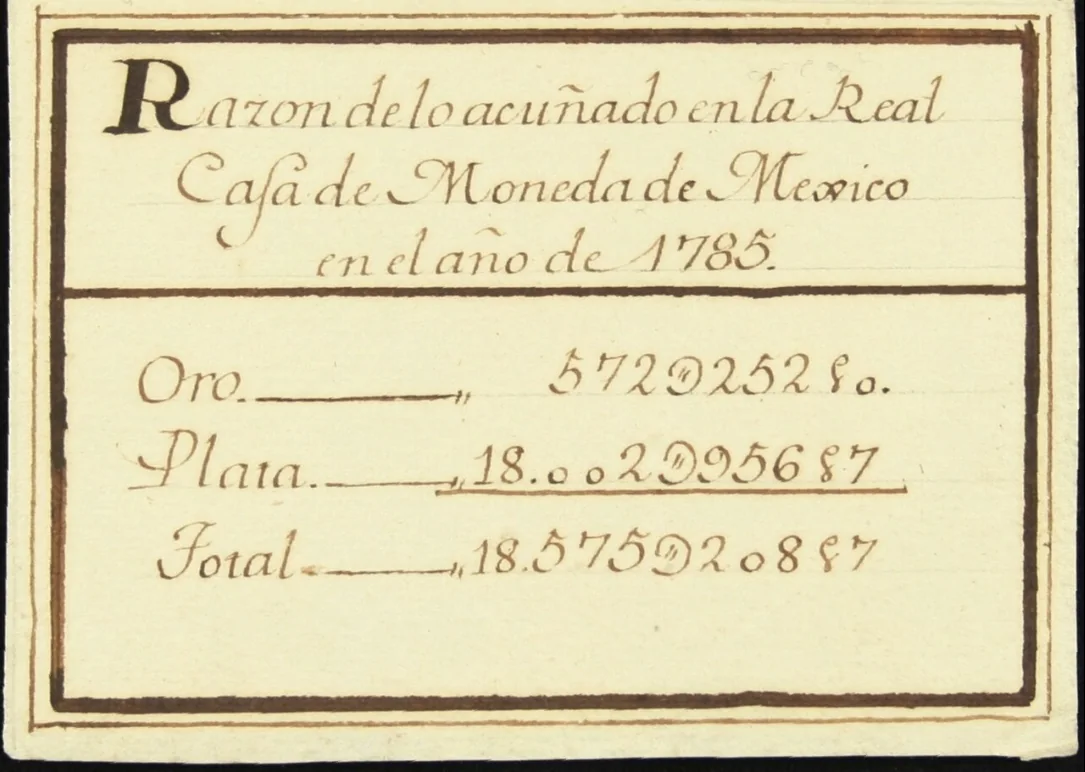
The sketches and dies for the new coinage were the work of Tomás Francisco Prieto, chief engraver of the Royal Mint in Madrid, who distinguished the "Indian" bust, in the heroic manner, from the peninsular one, "bare with a kind of royal mantle". Mexican output soared: between 1772 and 1783 the mint struck an average of 18 million pesos a year, peaking in 1804 and 1805. An accounting document from the mint itself, the "Razón de lo acuñado en la Real Casa de Moneda de México en el año de 1785", confirms that order of magnitude: 18,002,956 pesos and 7 reales in silver and 572,252 pesos in gold, a total of 18,575,208 pesos and 7 reales in a single year. Silver accounted for almost 97%. And even so, according to Varela, the coinage was never enough for the viceroyalty's internal needs, because the large pieces ended up in Europe and Asia.
The Manila Galleon: the bridge between the Americas and Asia
A key piece was the Manila Galleon route, which linked Manila and Acapulco from 1565 to 1815. Silks, porcelain and other Asian goods travelled to the Americas; in the opposite direction went American silver, in great demand in China.
That demand is not explained by Spanish expansion alone. In China, silver was central to commercial and tax payments, and the Ming dynasty's tax reforms reinforced its use.
American silver also reached Asia via European and Indian Ocean routes, so the Galleon was an essential link, but not the only one. The result was a network in which an American coin paid for Asian goods that ended up being consumed in Europe: an early globalisation.
Chopmarks: checking the coin before trusting it
Many reales de a ocho that circulated in Asia bear small stamped marks: chopmarks. They were applied by merchants, money changers and financial houses after examining the piece. In the China trade, the specialists in verifying coins and metals were the shroffs.
The mark indicated that a recognised operator had accepted the coin, and a piece could accumulate several. The British Museum, for example, holds an 8 Reales of the Mexican Republic from 1861 with Chinese chopmarks.
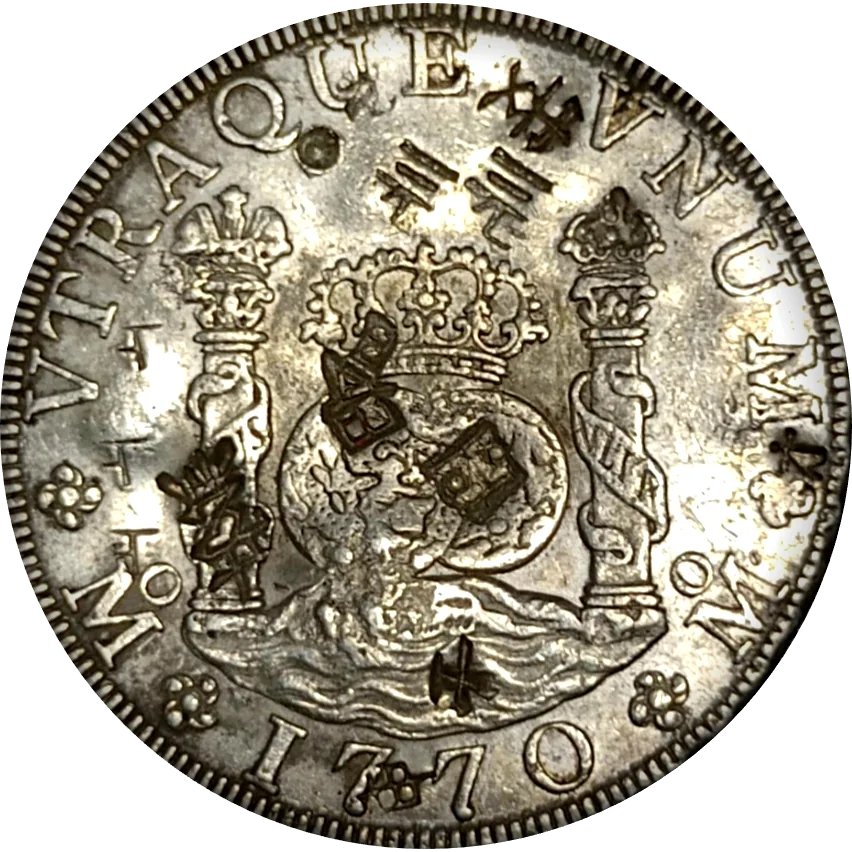
Its spread was such that in China each type received its own nickname. In a text from 1796, the jurist Wang Huizu recalled that before 1771 "foreign silver" hardly circulated and that it now circulated more than official silver, with a multitude of popular names and abundant counterfeits. The columnarios were the "double pillar" (shuangzhu) or "flower-edged silver" (huabianyin), after the edge, a name that ended up designating all foreign silver; also "Luzon silver", because it was believed to be made in the Philippines. The bust of Charles III was "three gong" (sangong), because the ordinal III resembled a Chinese character of that shape repeated three times, and also "Buddha silver" (foyin) because of the portrait; Charles IV was "four gong", and the bust of Ferdinand VII "small garment" (xiaoyi) or "new head" (xintou), as opposed to the "old head" (laotou) of Charles III. According to Gong Yibing's thesis, some 5,560 tonnes of silver entered China between the second half of the 18th century and the first half of the 19th. There is a documentary irony here: the Mexican "three gong" that conquered the Chinese market were the bust pieces that, from 1772, were struck with the secretly reduced fineness.
It is tempting to compare them to a private audit, but the comparison has its limits. Chopmarks did not form a universal certification system, and not all marks guaranteed the same quality.
They should also be distinguished from official countermarks, applied by an authority to validate a foreign coin or give it a local value. Holes, cuts and other alterations did not always serve the same purpose either.
For collectors, these marks are evidence of circulation. Their effect on price depends on rarity, condition, provenance and the buyer's taste: a marked piece is not necessarily worth more than a clean one.
That assessment has changed quickly. According to Adolfo Ruiz Calleja of Blog Numismático, around 2012 an 8 Reales with oriental chopmarks was worth half or a third of a clean one; a decade later, some chopmarked examples were already trading above unmarked pieces in similar condition. Even so, few dealers know how to catalogue chopmarks, and it is almost never possible to attribute a mark to a particular city or money changer.
The US dollar and the legacy of the Spanish peso
Foreign coins circulated in Britain's North American colonies, and the Spanish dollar held a prominent place among them. That familiarity made it the reference for the new US monetary system.
The Coinage Act of 1792 defined the dollar by reference to the machine-struck Spanish dollar then in circulation and set a content of 371.25 grains of pure silver, about 24.06 grams. The United States did not simply copy the real de a ocho: it created its own system, with legal specifications and decimal division. But the reference was explicit.
Spanish coins, and later Spanish American ones, continued to circulate until an 1857 law ended their federal legal-tender status.
The legacy is linguistic too. The expression "two bits", a quarter dollar, comes from the division into eight parts: two eighths make a quarter. Wall Street quotes long kept fractions from that tradition: the New York Stock Exchange moved from eighths to sixteenths in 1997 and completed the switch to decimal pricing in 2001.
Does the "$" sign come from here too?
A popular explanation links it to the Pillars of Hercules and their ribbons. It is appealing, but should not be presented as a proven origin. The best-supported explanation connects it to the handwritten abbreviation "ps" for pesos, whose superimposed and simplified letters would have produced the symbol. The link between the dollar and the Spanish peso is solid; the graphic origin of the sign calls for more caution.
A coin that outlived the empire
Independence in the Americas did not end demand for its minted silver. In the 19th century, the Mexican 8 Reales, with the eagle and the Phrygian cap, retained exceptional acceptance in Asia and extended the story of the Spanish dollar under a new sovereignty.
The episode of the "Balanza" peso is revealing. Mexico issued it between 1869 and 1873 as a decimal coin, with the same weight and fineness, but it was poorly received in the China trade. So as not to lose that market, President Sebastián Lerdo de Tejada restored the 8 Reales by decree of 29 May 1873, and that same year the mints began striking it again.
The case shows that a technically coherent change can clash with a format the market recognises and prefers. The Mexico City Mint kept evolving: the Monetary Reform of 1905 made coining an exclusive power of the State, changed the legend "República Mexicana" to "Estados Unidos Mexicanos" and laid the foundations of what twenty years later would become the Bank of Mexico.
Local adaptation also took place outside Asia. The Bank of England countermarked Spanish dollars between 1797 and 1804, amid a shortage of coin. In Japan, some Mexican pieces received the official countermark "Aratame San Bu Sada" in 1859–1860, during the opening to foreign trade.
Foreign silver dollars influenced the monetary systems of East Asia. Even so, saying that the real de a ocho "created" the yuan or the yen oversimplifies processes that included national reforms and other influences.
What its history teaches us today
The real de a ocho did not triumph by decree alone, but nor did it succeed independently of political power. Its expansion combined mining output, minting institutions, imperial networks, trade routes and merchants who trusted it. Several lessons follow:
- Standardisation makes trade easier, because it reduces the effort of checking what you receive.
- Trust needs verification mechanisms, especially when the parties are far apart and share no institutions.
- Acceptance breeds more acceptance: a currency's usefulness grows with its network of users.
- An established reputation can outlive the original issuer, as happened with Mexican silver after independence.
- Changing a familiar standard has costs, even when the reform seems reasonable.
These ideas still apply to international payments, trade certifications and collateral management. But there is an essential difference: the real de a ocho was worth its metal, whereas today's major currencies rest on different institutional frameworks.
Even that difference has nuances. As early as 1542 the Mexico City Mint was issuing copper billon whose face value far exceeded that of its metal. Fiat money is not a modern invention: it coexisted from the very start with full-value silver, though it was reserved for small payments and local use. And not even full-value silver was raw metal: the Ordinances of Cazalla of 1730 set seigniorage and minting charges at one-sixteenth, so that a mark of silver worth 80 reales as a bar became coins worth 85. What travelled the world was coin that was worth, above all, what it weighed.
For some three centuries, silver minted in the Americas connected economies separated by oceans. The real de a ocho was a shared instrument of payment and trust, built on a history of commercial innovation, imperial power and high human costs.
Sources and further reading
- Royal decree and ordinances on the Mexico City Mint, Madrid, 11 May 1535. Transcription of the original document on Mexican Numismatics (USMEX).
- Royal decree on the value of reales brought from Castile to New Spain, Madrid, 31 May 1535. Transcription on Mexican Numismatics (USMEX).
- Royal decree authorising the viceroy to strike reales de a ocho, Monzón, 18 November 1537. Transcription on Mexican Numismatics (USMEX).
- Mendoza authorises the striking of billon maravedís, Mexico City, 28 June 1542. Historical account of the measure, not the original text, on Mexican Numismatics (USMEX).
- Ordinance for the mints of Spain and the Indies, Madrid, 9 June 1728. Transcription on Mexican Numismatics (USMEX).
- Ordinances of Cazalla on the making of coins, their fineness and assays, 16 July 1730. Transcription on Mexican Numismatics (USMEX).
- Proclamation by Viceroy Juan de Acuña on the new coinage, Mexico City, 23 December 1732. Transcription and image of the proclamation on Mexican Numismatics (USMEX).
- Secret royal decree lowering the fineness of the coinage, El Pardo, 18 March 1771. Transcription of the copy certified in Mexico City on 9 June 1771, on Mexican Numismatics (USMEX).
- Pragmatic of Charles III on the new coinage, Aranjuez, 29 May 1772. Transcription and image on Mexican Numismatics (USMEX).
- Casa de Moneda de México, "Antecedentes de creación". Institutional text on the founding, stages and premises of the mint.
- Varela, J. (2022). Los reales de a 8 desde Felipe III a Fernando VII. We are Numismatics, on the occasion of Ibercoin's "Colección Conde de Aranda" auction. CC BY-NC-ND 4.0 licence.
- Ruiz Calleja, A. (2022). Así llamaban los chinos a los 8 reales españoles. Blog Numismático. Includes Wang Huizu's text (1796) and the Chinese names according to Gong Yibing's master's thesis.
- García Guerra, E. M. (2006). Itinerarios mundiales de una moneda supranacional: el real de a ocho o peso durante la Edad Moderna. Studia Historica. Historia Moderna, 28. University of Salamanca.
- Banco de México: Historia del Banco de México, volume I, introduction. Mentions the founding of the Mexico City Mint in 1535.
- British Museum: 8 Reales of the Mexican Republic (1861) with Chinese chopmarks, CH.83.
- Federal Reserve Bank of Atlanta, Clash of the Coins: Spanish Milled Dollar. Coinage Acts of 1792 and 1857.
- USMEX: The 8 Reales of Oaxaca 1870, on the decree of 29 May 1873.
- Huntsinger and Leverage: Chopmarks on Mexican Silver.
- BBC News Mundo: el real de a ocho, la moneda internacional del imperio español.
- Larreal, H.: How the 8 Reales Became a World Currency, CoinsWeekly.