The Mexican “Balanza” Onza Troy (1949-1980): history, types, varieties and NGC and PCGS census data
History of the troy ounce and a complete guide to Mexico's Balanza onza: Types 1 to 5, 1980 overdates, NGC and PCGS census data and which varieties to look for.
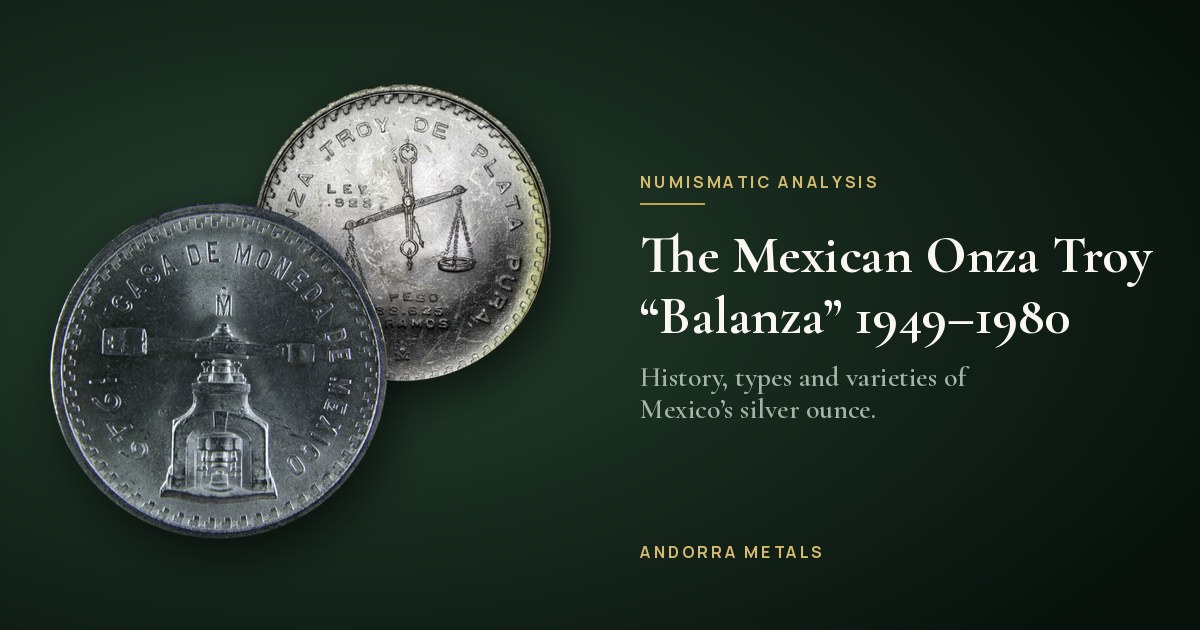
In my view, the Balanza onza is the coin that best sums up two stories at once: that of a medieval unit of weight that now sets the world price of silver, and that of the oldest mint in the Americas. It was struck in 1949 and again in 1978, 1979 and 1980, around 11.9 million pieces in total, before giving way to the Libertad in 1982.
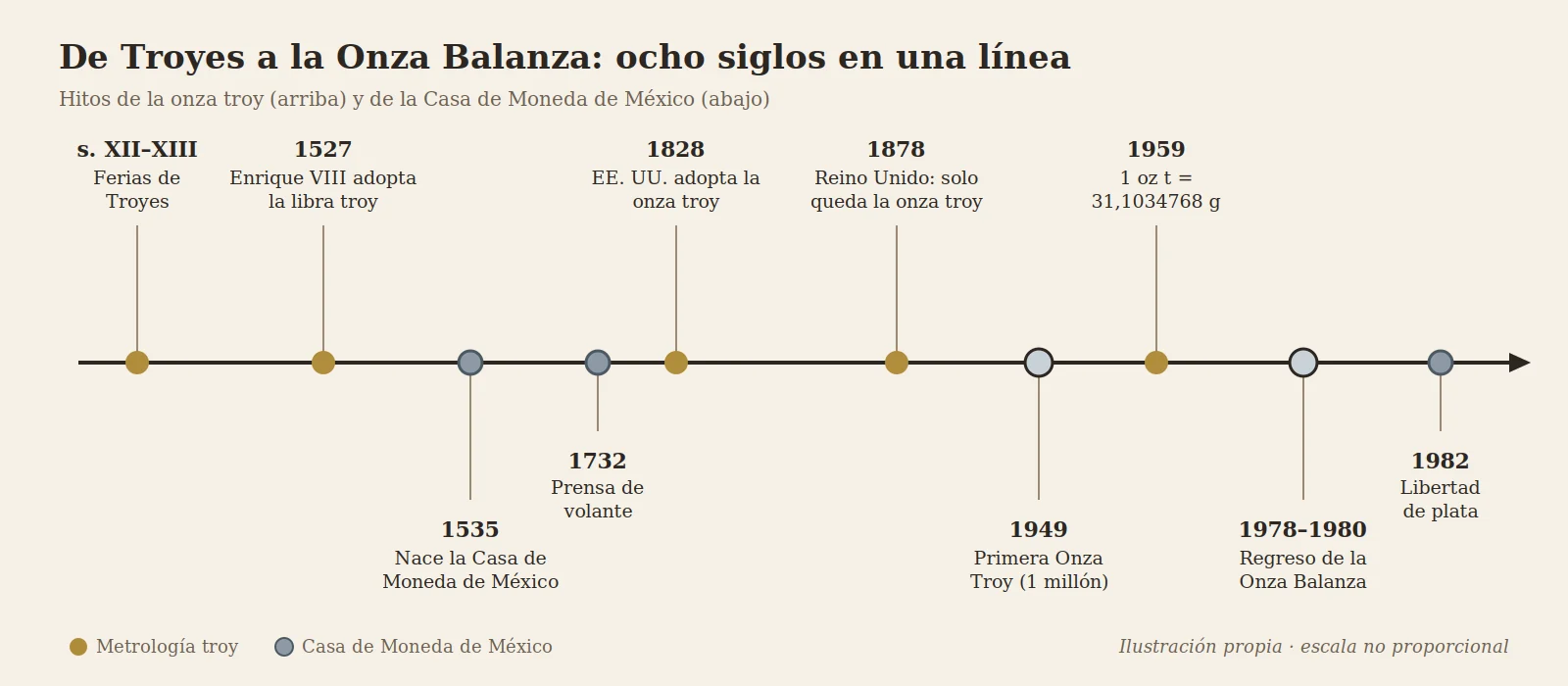
In this article I start with the origin of the troy ounce, because without it the coin's legend makes no sense. Then I explain its types, its varieties and what genuinely deserves a premium. The photographs show real coins; the timeline and diagrams are Andorra Metals drawings (labelled in Spanish).
1. The troy ounce: from a medieval fair to the exact gram
The troy ounce weighs exactly 31.1034768 grams, and that figure is the result of eight centuries of history. According to the most widely accepted view, its name comes from Troyes, the city in Champagne whose fairs brought together merchants from all over Europe in the Middle Ages.
The grain: the seed that measures everything
The base unit is the grain, nominally the weight of an ideal cereal seed. The troy scale is built like this:
- 24 grains = 1 pennyweight (dwt)
- 20 pennyweights = 1 troy ounce = 480 grains
- 12 troy ounces = 1 troy pound = 5,760 grains
The grain is the only link shared by the troy, avoirdupois and apothecaries' systems. That is why the Mexico City Mint chose 480 grains for its legend: a way of speaking the universal language of precious metals.
Henry VIII and the end of the Tower pound
Until the 16th century, the English mint at the Tower of London used the Tower pound, with ounces of 450 grains. Henry VIII abolished it in 1527 and adopted the troy pound for coinage. Ever since, English gold and silver have been weighed in troy.
From London to the world
The United States adopted the British imperial troy ounce as the official standard for its coinage by Act of Congress on 19 May 1828. In the United Kingdom, the Weights and Measures Act of 1878 withdrew the troy pound and left only the troy ounce and its decimal subdivisions as official.
The final step came on 1 July 1959. Six English-speaking countries fixed the grain at exactly 64.79891 milligrams. Multiplied by 480, that gives the 31.1034768 g used today by the LBMA, COMEX and every bullion dealer.
A paradox worth knowing
The troy ounce is heavier than the ordinary ounce, but the troy pound is lighter than the ordinary pound, because it has 12 ounces rather than 16.
| Unit | Grains | Grams |
|---|---|---|
| Troy ounce | 480 | 31.1035 |
| Tower ounce (until 1527) | 450 | 29.16 |
| Avoirdupois ounce (the ordinary one) | 437.5 | 28.3495 |
| Troy pound (12 oz) | 5,760 | 373.24 |
| Avoirdupois pound (16 oz) | 7,000 | 453.59 |
That is why a kitchen scale set to “ounces” is never any use for checking an investment coin: it measures the avoirdupois ounce, which is 8.9% lighter.
2. Why the Balanza onza weighs 33.625 grams
The coin weighs 33.625 g because it is .925 sterling silver, not pure silver: 33.625 × 0.925 = 31.103 g of fine silver, exactly one troy ounce. The remaining 2.52 g is mostly copper.
| Specification | Value |
|---|---|
| Fineness | .925 (92.5% silver) |
| Gross weight | 33.625 g |
| Fine silver | 31.1035 g (1 troy oz) |
| Alloy | 2.52 g, mainly copper |
| Diameter | approx. 41 mm |
| Edge | Reeded |
| Mint | Mo (Mexico City) |
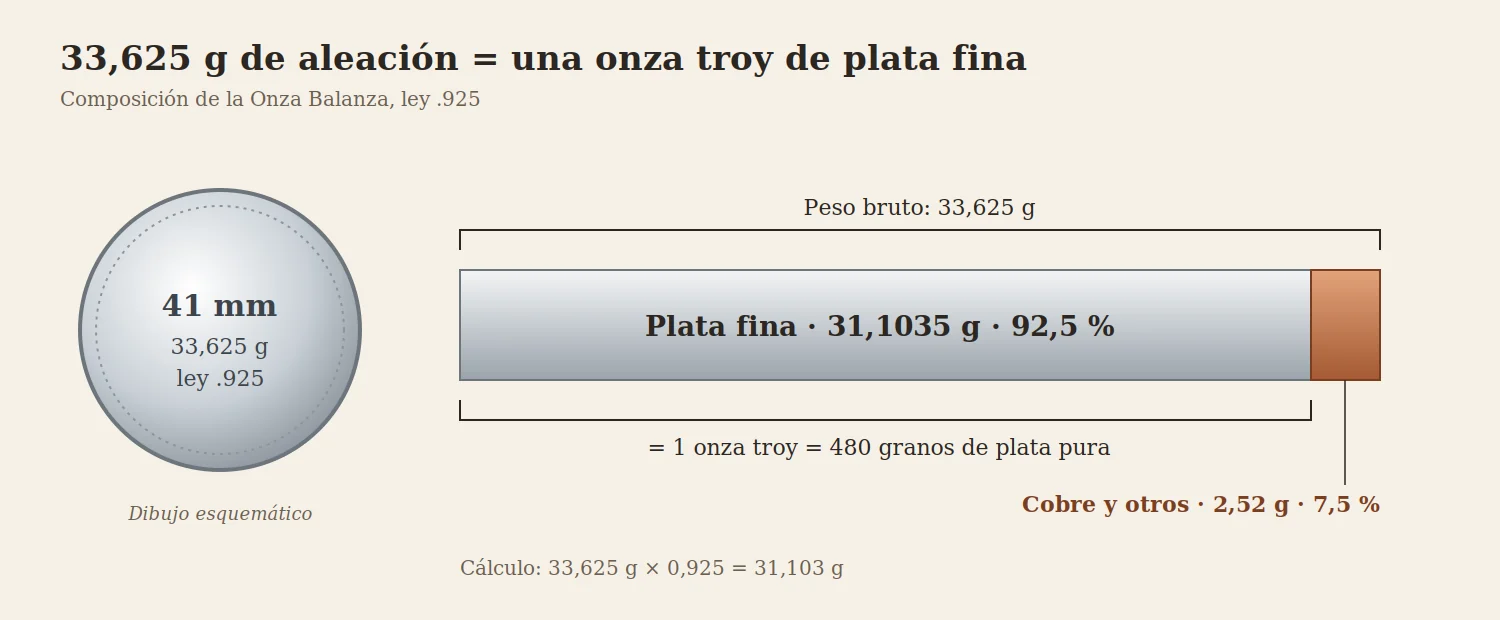
A detail many texts overlook: the legend changes between issues. The 1949 coin reads “UNA ONZA TROY = 480 GRANOS DE PLATA PURA”. The 1978 to 1980 coins simplify it to “UNA ONZA TROY DE PLATA PURA” and add the fineness, the weight in grams and the mint mark. If someone offers you a 1979 with the 480-grain legend, be suspicious.
Another important point: these onzas carry no face value. Technically they are medallic pieces from the Mint, which is why catalogues such as Numista list them separately from legal-tender coinage.
3. The Mexico City Mint and the 1949 issue
The 1949 onza is the founding coin: one million pieces, catalogued as KM-M49a. Behind it lie more than four centuries of craft.
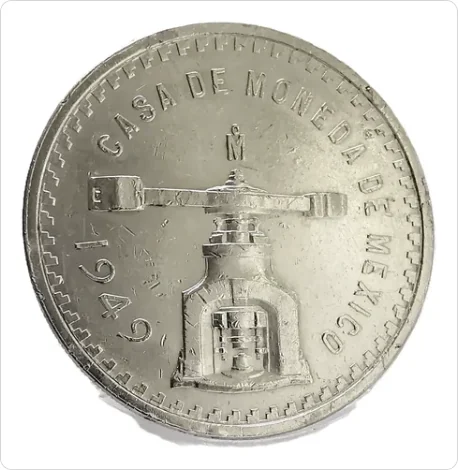
The Mexico City Mint was founded in 1535, when Viceroy Antonio de Mendoza received its charter. In the 17th and 18th centuries its silver circulated across the Americas, Europe and Asia, and the 8 reales became the first global currency.
In the 20th century silver disappeared from everyday pockets. The 1949 Onza Troy responded with something new: metal of guaranteed weight and fineness, designed for saving rather than for change.
A Bank of Mexico project
The initiative was led by Rodrigo Gómez, then deputy director of the Bank of Mexico. His aim was to show that international trade could be settled with standard-weight pieces instead of silver bars, which were slow and expensive to handle and calculate.
The Mint's 1949 annual report records that the million pieces were struck between May and June that year, using 24 obverse and 25 reverse dies. That works out at about 41,666 onzas per pair of dies. They sold for 6 pesos each.
The standard study of this series, by Scott Doll, fills in the picture. According to Doll, it was the Bank of Mexico that asked the Mint for a piece the size of a large peso with no face value, with a threefold aim: to satisfy a public that missed the large silver coins, to put the Government's metal reserves to use and to show the world what the Mint could do. Its initial price was equivalent to one dollar, and Mexican and foreign banks went on selling it until 1961, when the rising silver price forced sales to be suspended. The Mexican public nicknamed it the “Tejo”.
Who designed it
The design is attributed to Manuel Luna Negrete, and there is a 1947 pattern that anticipates the coin. The same engraver had already used the screw press on the medal for the Mint's 400th anniversary in 1935.
Was it the first silver bullion coin?
I prefer to put it cautiously: it was one of the first modern one-ounce silver pieces issued by a state mint for saving. PCGS does describe it as the first government-issued silver bullion coin, but the idea of bullion as we understand it today took hold later, with the 1967 Krugerrand and the 1979 gold Maple Leaf.
What to check on a 1949
With this date, what matters is not the variety but condition and authenticity. I always check:
- weight (33.6 g) and diameter (41 mm);
- signs of harsh cleaning or artificial shine;
- edge knocks and scratches in the fields;
- toning spots or corrosion.
4. The comeback: 1978, 1979 and 1980
After a 29-year pause, the series returned with rising mintages, from 280,000 pieces in 1978 to 6.1 million in 1980.
| Year | Approx. mintage | Types | KM reference |
|---|---|---|---|
| 1980 | 6,104,000 | Type 5 | M49b.5 |
| 1979 | 4,508,000 | Types 3 and 4 | M49b.3 / M49b.4 |
| 1978 | 280,000 | Types 1 and 2 | M49b.1 / M49b.2 |
| 1949 | 1,000,000 | Single type | M49a |
The Mexican press announced the return of the onzas on 23 February 1979, at an initial price of 205 pesos. Everything suggests that the coins dated 1978 were already distributed in 1979.
The timing was no accident. Between 1979 and 1980 silver went through one of its biggest speculative surges, and the public wanted physical metal. In 1982 the silver Libertad arrived, and the Balanza onza closed with four official dates.
There is one curiosity outside the series: in 1989 the Mint made a special, limited issue known as the “Onza del Capricho” (the whim onza). According to the stories that circulate, it was struck at the wish of a senior Mint official. It is not one of the four official dates.
A word of caution: the fact that 1978 has the lowest mintage does not mean both of its types are equally rare. There is no official breakdown of how many coins are Type 1 and how many are Type 2.
5. Type guide: telling 1 to 5 apart
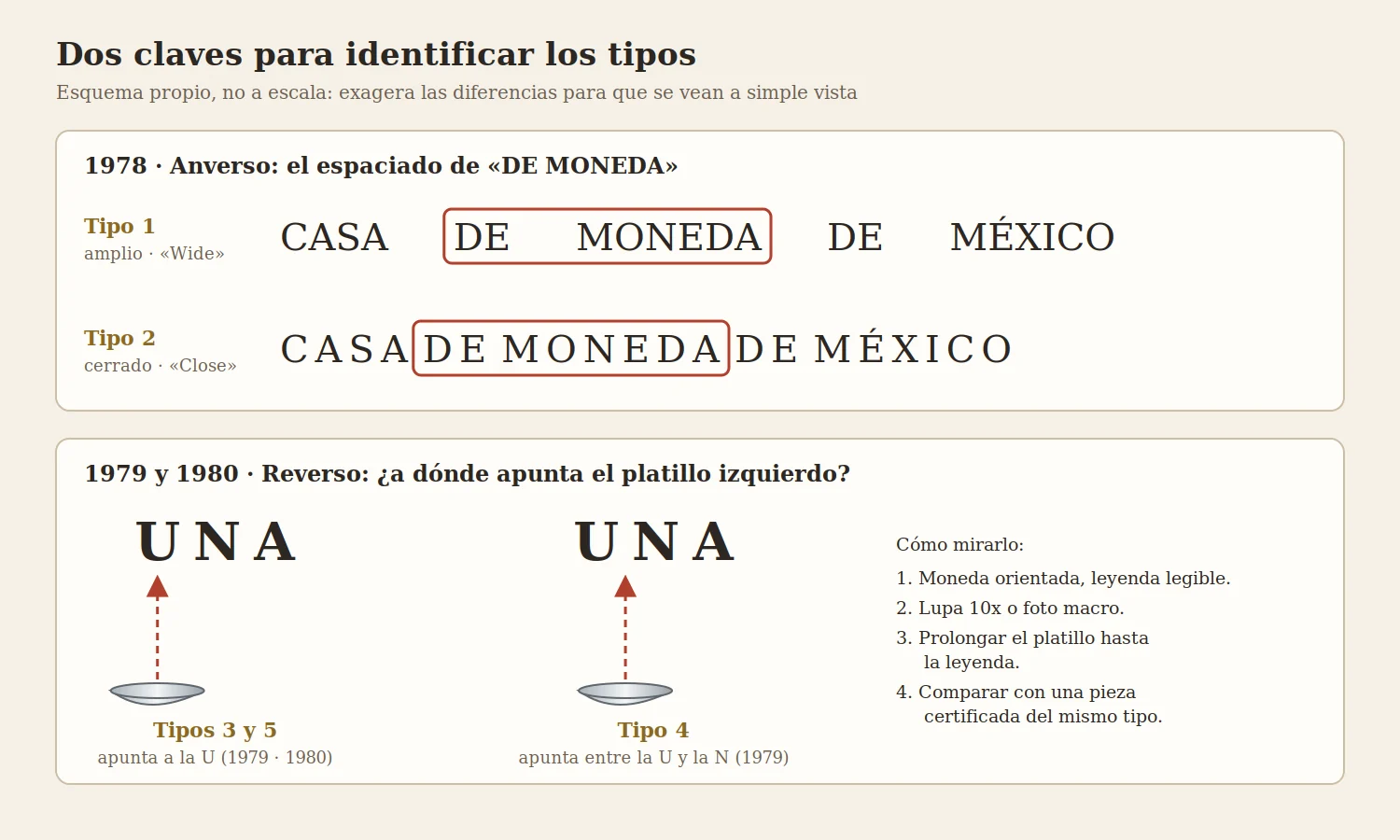
The modern series falls into five catalogue types, plus the founding 1949 date. Two clues are enough to identify them: the spacing of “DE MONEDA” on the obverse and the position of the left pan relative to the word “UNA” on the reverse.
| Type | Year | KM | Obverse: “DE MONEDA” | Reverse: left pan |
|---|---|---|---|---|
| Type 1 | 1978 | M49b.1 | Wide spacing (NGC: “Wide”) | — |
| Type 2 | 1978 | M49b.2 | Close spacing (NGC: “Close”) | — |
| Type 3 | 1979 | M49b.3 | Close | Points to the U of UNA |
| Type 4 | 1979 | M49b.4 | Close | Points between the U and the N |
| Type 5 | 1980 | M49b.5 | — | Points to the U of UNA |
In 1978 the difference is on the obverse: on one type the words of the legend are further apart and the letters closer together, and on the other it is the reverse. In 1979 you have to turn the coin over and look at the reverse.
How I check it in practice
- I hold the coin with the reverse legend upright, without rotating it.
- I use a 10x loupe or a macro photo with angled light.
- I extend the line of the left pan up to the legend and note which letter it points to.
- I compare it with an already graded example of the type being offered.
On circulated or dirty coins the difference can be misleading. If the type changes the price, I insist on an enlarged photo or a slab.
6. The 1980 overdates: where the market gets it wrong most
1980 is the highest-mintage year and, at the same time, the most interesting for advanced collectors, because some dies were reused from earlier dates. The attributions in circulation are 1980/9, 1980/79 and an “8/7” that appears in some PCGS records. Catalogues such as Foronum and Numista also list a 1980/70 designation, in the latter case linked to trial strikes.
My rule is simple: a shadow under the zero is not an overdate. Before paying a premium I check:
- that the shape of the trace matches the digit being claimed;
- that it is in the right position on the die;
- that the same feature repeats on other attributed examples;
- that a grading company confirms it with an explicit attribution on the label.
Many coins advertised as 1980/79 show nothing more than bag marks, dirt or die wear. If the price difference is significant, grading stops being a cost and becomes insurance.
7. The obverse: the screw press
The obverse carries not the national eagle but a screw press, the machine that in 1732 allowed the Mexican mint to make round coins with a protective edge. It is the Mint's tribute to its own craft.
How it worked
One die was fixed in the base. The other was attached to a threaded shaft turned by a horizontal arm with counterweights at each end. As it turned, the shaft came down hard and struck the blank placed between the two dies.
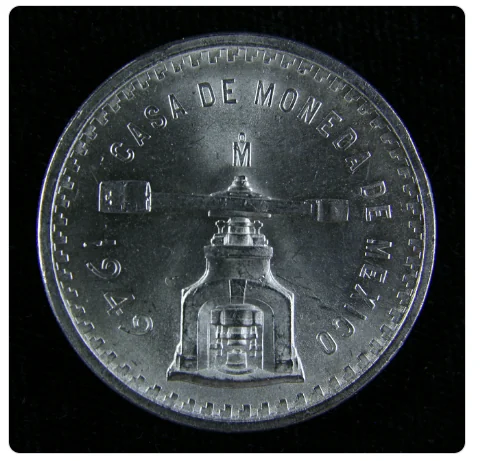
The technical leap was huge. Irregular, hammer-struck cobs that were easy to clip gave way to the round pillar 8 reales, protected against filing.
A necessary correction
It is often said that the 1732 press was of British origin. I have found no support for that claim. The sources I consulted link it to the Bourbon reforms of Philip V, when the Crown took back direct control of the mint, and one of them mentions machines of French invention. Until documentation turns up, I prefer not to assert a British origin.
The message of the obverse is clear: tradition, technical capability and the authority of the mint that guarantees the coin.
8. The reverse: the balance and the British legend
The balance scale on the reverse, tilted to the left, gives the series its popular name. For an investment coin the symbol is perfect: it conveys verified weight, controlled fineness and honest trade.
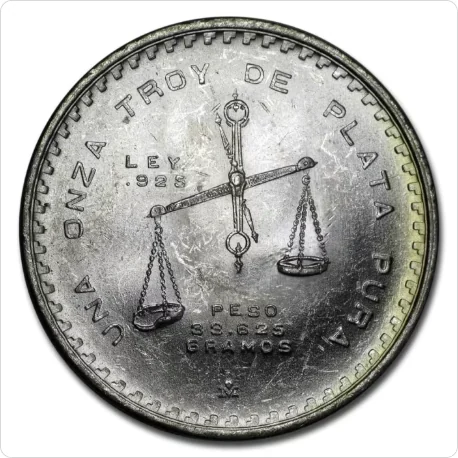
The story of the London balance
Dealers say the engraving reproduces a British precision balance, sometimes attributed to De Grave, Short & Co. The firm existed and has a pedigree: it traded from St. Martin's-le-Grand in London and in 1882 advertised itself as supplier to the Royal Mint and the Assay Office at Goldsmiths' Hall, making bullion and assay balances. London's Science Museum holds one of its assay balances from the Royal Mint.
The story is plausible: the troy system is Anglo-Saxon, London was the great centre for precision instruments and mints used those balances. But plausible is not proven.
What it would take to confirm it
- invoices or inventories from the Mint or the Bank of Mexico;
- photographs of the instrument;
- sketches or correspondence from the engraver.
Until something like that turns up, I present it as tradition, not fact. What is certain is the message: the coin brings together the mint, the instrument that controls weight and the guarantee of one troy ounce of fine silver.
9. What earns a premium and what doesn't: a practical guide
Not all differences are worth the same. I separate three levels before talking about price.
| Level | What it includes | Liquidity | My view |
|---|---|---|---|
| Catalogue types | 1949 and Types 1 to 5 | High | The basis of any type collection |
| Varieties attributed by a grading company | 1980 overdates (1980/9, 1980/79, 8/7) | Medium | Premium only with a slab and attribution on the label |
| Collector micro-varieties | Beam pattern (B1-B5), shifted last 9, die dots | Low | Good for cherry-picking, no guaranteed premium |
PCGS and NGC do not always use the same names or numbers. Each company's label may describe the same coin differently, and that is normal.
Before buying, I check
- Weight close to 33.6 g and a diameter of about 41 mm
- The correct legend for the date (480 grains only in 1949)
- The type verified from a macro photo, not the seller's description
- No cleaning, edge knocks or deep scratches in the fields
- For 1980, that a high grade (MS66 or above) justifies the extra cost
- Grading if the premium clearly exceeds the cost of slabbing
A 1980 is common by mintage, but an MS67 example with original lustre is scarce. Mintage is never a substitute for condition.
As a historical reference, in 2014, with silver at around 20 dollars, Scott Doll estimated that a common high-grade onza sold at 25-35% over spot. The 1949 in BU fetched 2.5 to 3 times spot, and the 1980 overdates and the 1978 Type 2, 1.5 to 2 times. These figures are more than a decade old and should be checked against recent auctions. In addition, the census in section 10 qualifies his view that the Type 2 is hard to find.
Doll also stresses that many dealers do not sort the varieties, which makes it possible to find scarce types at the price of a common onza. It is the same practical conclusion as this article.
10. What the PCGS and NGC census data say
The PCGS population report confirms that the 1949 is scarce in high grade: only 19 coins in MS66 or above and none above MS67, out of 570 graded. A telling detail: PCGS does not list these onzas among coins but in its tokens and medals category, consistent with their having no face value.
1949 (KM-M49a) at PCGS, MS grades
| MS61 | MS62 | MS63 | MS64 | MS65 | MS66 | MS67 | Total |
|---|---|---|---|---|---|---|---|
| 9 | 54 | 191 (+3) | 190 (+4) | 79 (+3) | 18 | 1 | 570 |
In brackets, coins with a “+” designation. The total includes circulated grades. PCGS data as of 29-09-2026.
1978-1980: individual PCGS data points
For the modern types I could not extract the full table, but the PCGS listings give useful reference points:
| Coin | PCGS population data | Reading |
|---|---|---|
| 1978 Type 1 (M49b.1) | 59 coins above MS65 and 88 below | About 59 in MS66 or above |
| 1978 Type 2 (M49b.2) | 91 in MS66 and 4 above | About 95 in MS66 or above |
| 1980 Type 5 (M49b.5) | 378 in MS65 and 226 above | Plentiful even in gem grade |
| 1980/79 | 241 in MS66 and 42 above | A common overdate at PCGS |
| 1980/9 | 7 in MS67 and none above | The scarcest overdate |
Two conclusions of my own. First: in high grade, the 1978 Type 2 is no scarcer than the Type 1 at PCGS, which is a reason for caution when someone sells it as “much rarer”. Second: the 1980/79 has hundreds of coins graded MS66, so it does not justify a large premium; the 1980/9 really is the difficult overdate, as PCGS itself points out.
These figures come from different listings and may not all be from the same day; it is worth checking them in the population report before a significant purchase.
NGC
The NGC census points the same way as PCGS: in 1978 there are more graded coins of the “Close” type (Type 2) than of the “Wide” type (Type 1). NGC lists the series under Mexico 1905 To Date, 1 Onza.
| NGC attribution | Equivalent to | Designation | Total graded |
|---|---|---|---|
| 1949Mo | KM-M49a | MS | 618 |
| 1978Mo no variety | Type not attributed | MS | 187 |
| 1978Mo no variety | Type not attributed | MSPL | 1 |
| 1978Mo “Casa de Moneda” Close | Type 2 | MS | 164 |
| 1978Mo “Casa de Moneda” Wide | Type 1 | MS | 91 |
| 1978 7/7Mo “Casa de Moneda” Wide | Type 1, repunched date | MS | 26 |
| 1979Mo no variety | Type not attributed | MS | 680 |
| 1979Mo Pan Points to “U” | Type 3 | MS | 192 |
| 1979/9Mo Pan Points to “U” | Type 3, repunched date | MS | 59 |
| 1979/9Mo Pan Points to “U” | Type 3, repunched date | MSPL | 1 |
| 1979Mo Pan Points to “U” With Dot Before Year | Type 3, dot before date | MS | 29 |
| 1979Mo Pan between “U” & “N” | Type 4 | MS | 205 |
| 1979/9Mo Pan between “U” & “N” | Type 4, repunched date | MS | 28 |
| 1979Mo Pan between “U” & “N” With Dot Before Year | Type 4, dot before date | MS | 11 |
| 1980Mo no variety | Type 5 | MS | 1,292 |
| 1980Mo no variety | Type 5 | MSPL | 1 |
| 1980Mo High “0” | Type 5, high zero | MS | 48 |
| 1980Mo “0” Slanted Right | Type 5, zero slanted right | MS | 27 |
| 1980Mo “0” Slanted Left | Type 5, zero slanted left | MS | 11 |
| 1980Mo High “8” | Type 5, high eight | MS | 63 |
| 1980/79Mo | Overdate | MS | 136 |
| 1980/79Mo | Overdate | MSPL | 2 |
| 1980 8/7Mo | Overdate 8 over 7 | MS | 47 |
| 1980Mo “80” Slanted Left | Type 5, “80” slanted left | MS | 12 |
| 1980Mo 8/8 | Type 5, repunched eight | MS | 7 |
| 1980/70Mo | Overdate | MS | 13 |
NGC census data checked on 30-09-2026. The grade breakdown for 1949 and 1978 appears below.
For 1949, NGC records 618 coins, slightly more than the 570 at PCGS; between them the two companies have graded around 1,200 examples of the founding date.
For 1978, adding the two Wide varieties together, NGC records 117 Type 1 coins against 164 Type 2, plus 187 with no type assigned. With two grading companies in agreement, my conclusion is firm: there is no basis for charging for the Type 2 as the scarce 1978 variety. NGC also recognises a 7/7 variety with a repunched date, which does not appear in the catalogues I cite and is worth checking on any Type 1 that comes through the shop.
For 1979, NGC splits the attributed coins into 281 Type 3 and 244 Type 4, but another 680 are listed with no type. That unattributed figure is the key: many coins are slabbed without requesting the variety, so the census does not measure the true rarity of each type, only what submitters chose to have attributed. The minor varieties are the scarcest in the census: the Type 4 with a dot before the date totals just 11 coins, and the 1979/9 dates between 28 and 60.
For 1980, NGC has graded 1,292 normal coins, the highest figure in the series and consistent with its 6.1 million mintage. It also distinguishes a range of varieties by the position or repunching of the date digits: high eight (63), high zero (48), zero slanted right (27), “80” slanted left (12), zero slanted left (11) and repunched eight 8/8 (7). That last one is the scarcest variety in the whole census so far. These are die features visible only under a loupe, and worth checking on any 1980 that comes into the shop.
On the overdates, NGC confirms three things. The 1980/79 is relatively common, with 138 coins, in line with PCGS. The 8/7 attribution, which I presented cautiously in section 6, is recognised by NGC with 47 coins, so it is an established variety. And the 1980/70 appears with only 13 coins.
A striking point: NGC has no separate row for the 1980/9, which at PCGS is the scarce overdate. Each company attributes these overdates in its own way, and a PCGS 1980/9 may correspond to a different label at NGC or appear as a normal 1980. Before paying a premium for an overdate, I check which company graded it and how the label describes it.
NGC grade breakdown: 1949 and 1978
The breakdown confirms there is almost nothing above MS66: the 1949 has no coins above it at NGC and only one at PCGS. In 1978, high grades turn the usual idea on its head: the Type 1 is the scarce one, not the Type 2.
| NGC row | Details | AU58 | MS61 | MS62 | MS63 | MS64 | MS65 | MS66 | MS67 | Total |
|---|---|---|---|---|---|---|---|---|---|---|
| 1949 | 59 | 6 | 30 | 103 | 211 | 151 | 40 | 18 | 0 | 618 |
| 1978 no type | 7 | 1 | 1 | 6 | 31 | 78 | 48 | 15 | 0 | 187 |
| 1978 Close (T2) | 2 | — | — | 7 | 22 | 73 | 41 | 19 | 0 | 164 |
| 1978 Wide (T1) | 4 | — | — | 6 | 23 | 31 | 22 | 4 | 1 | 91 |
| 1978 7/7 Wide (T1) | — | — | — | 1 | 4 | 11 | 6 | 3 | 1 | 26 |
Each grade includes its “+” and star designations. “Details” combines AU Details and UNC Details (problem coins). No coin grades above MS67. NGC census checked on 30-09-2026.
Three readings of my own:
- The 1949 calls for watching out for cleaning. 59 of its 618 coins (almost 10%) carry a Details label for some problem, compared with around 3% for 1978.
- MS66 is the real ceiling for the 1949. There are only 18 at NGC and 18 at PCGS, plus a single MS67 at PCGS. A 1949 in MS66 is a top-tier coin.
- The 1978 Type 1 is the hard one in high grade. In MS66 or above, the Type 1 totals 9 coins (counting the 7/7) against 19 for the Type 2. And the only two 1978 MS67s at NGC are Type 1. PCGS points the same way, so a Type 1 in MS66 deserves a higher premium than a Type 2 in the same grade.
NGC grade breakdown: 1979
In 1979 the normal Type 3 is the difficult one in high grade: only 8 coins in MS66, against 19 Type 4 coins in MS66 or above.
| NGC row | Details | AU58 | MS61 | MS62 | MS63 | MS64 | MS65 | MS66 | MS67 | Total |
|---|---|---|---|---|---|---|---|---|---|---|
| 1979 no type | 15 | 1 | 1 | 31 | 145 | 256 | 167 | 60 | 4 | 680 |
| 1979 Type 3 | 5 | — | 7 | 33 | 62 | 51 | 26 | 8 | 0 | 192 |
| 1979/9 Type 3 | — | — | 5 | 12 | 20 | 15 | 6 | 1 | 0 | 59 |
| 1979 T3 with dot | 1 | — | — | 4 | 8 | 8 | 4 | 4 | 0 | 29 |
| 1979 Type 4 | 8 | 1 | 1 | 12 | 47 | 64 | 53 | 17 | 2 | 205 |
| 1979/9 Type 4 | — | — | — | 1 | 7 | 10 | 7 | 3 | 0 | 28 |
| 1979 T4 with dot | 1 | — | — | 1 | 3 | 4 | 2 | 0 | 0 | 11 |
Same criteria as the previous table. No coin grades above MS67. NGC census checked on 30-09-2026.
The pattern repeats in 1978 and 1979: the variety the market considers common is not always the easy one in high grade. That is why, on a coin graded MS66 or above, I always ask for the type attribution on the label before pricing it.
NGC grade breakdown: 1980
The normal 1980 is the best date for anyone looking for a Balanza onza in high grade: NGC has 139 coins in MS66 and 8 in MS67, the highest figures in the whole series.
| NGC row | Details | MS61 | MS62 | MS63 | MS64 | MS65 | MS66 | MS67 | Total |
|---|---|---|---|---|---|---|---|---|---|
| 1980 normal | 14 | 2 | 45 | 217 | 455 | 412 | 139 | 8 | 1,292 |
| 1980 High “0” | 1 | — | 8 | 12 | 20 | 6 | 1 | 0 | 48 |
| 1980 High “8” | 2 | 4 | 2 | 14 | 22 | 11 | 8 | 0 | 63 |
| 1980/79 | 1 | 1 | 5 | 31 | 42 | 41 | 14 | 1 | 136 |
| 1980 8/7 | 3 | 1 | 1 | 12 | 15 | 11 | 3 | 1 | 47 |
Same criteria as the previous tables. I have left out the rows for zero slanted right and left, slanted “80”, 8/8 and 1980/70: in the text copied from the census it is not possible to tell with certainty which grade each figure belongs to. NGC census checked on 30-09-2026.
Two readings. The 1980 varieties are difficult in high grade: the High “0” has a single coin in MS66 and the 8/7 only three, so a clear premium can be justified there. And the 1980/79 shows a striking difference between companies: NGC has 15 coins in MS66 or above, while PCGS records more than 240 in MS66 alone. Before paying for a high-grade 1980/79, check which company's slab it is in.
11. Visual guide: how to recognise each variety
Each variety is identified by a single feature, visible with a 10x loupe and angled light. The photos come from NGC's variety attribution catalogue; I have grouped them by date for side-by-side comparison.
1978: check “DE MONEDA”, then the date
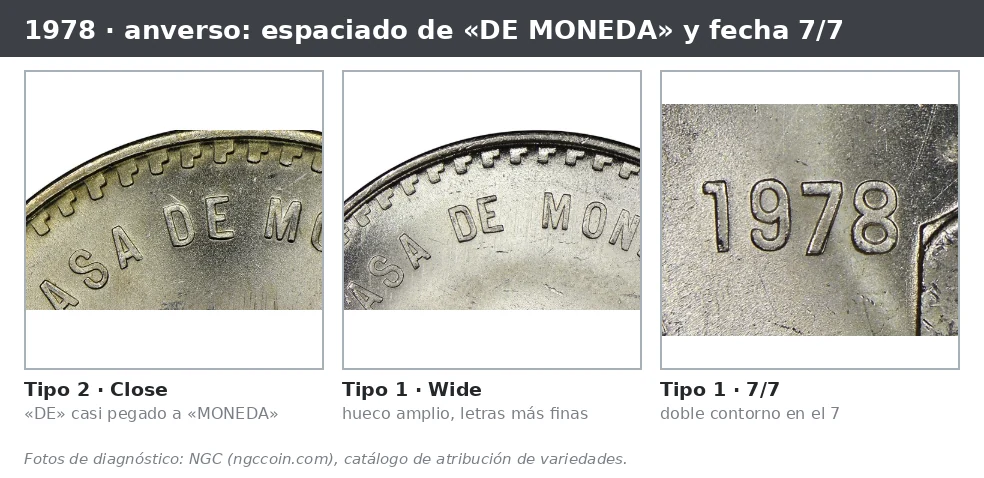
First the gap between “DE” and “MONEDA”: almost none on the Type 2, wide on the Type 1. If it is a Type 1, I check the 7 in the date for the double outline of the 7/7 variety.
1979: the pan first, then the date
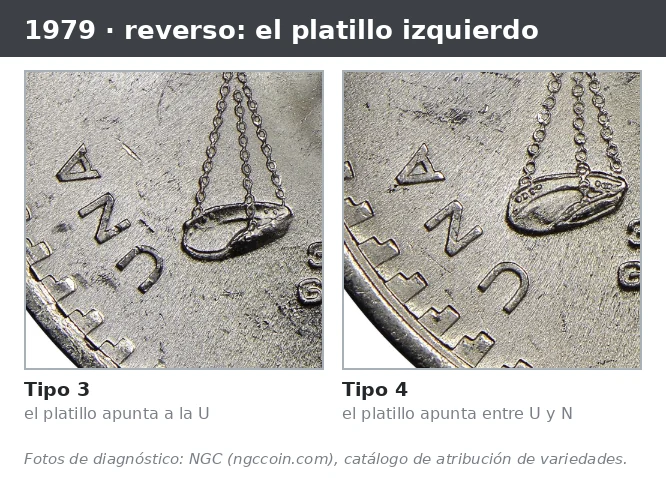
With the coin oriented as in the photo, the left end of the pan lines up with the U on the Type 3 and with the gap between the U and the N on the Type 4.
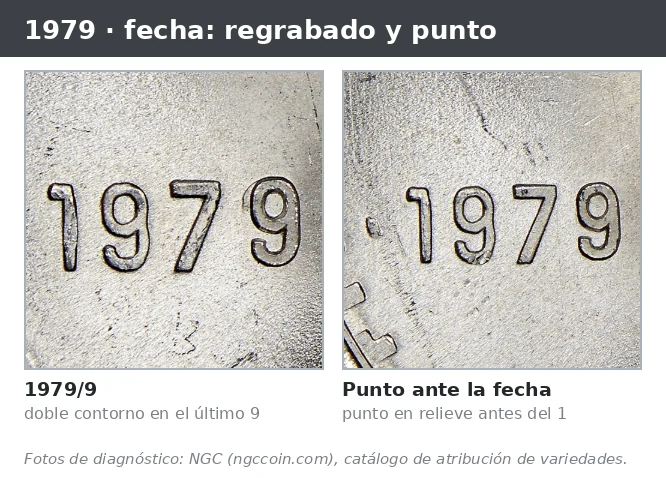
Then the date: a double outline on the last 9 indicates 1979/9, and a raised dot to the left of the 1 indicates the dot variety. Both features appear on the Type 3 and the Type 4.
Doll describes the dot before the date as a die defect of the Type 3, similar to the well-known dot on the 1954 brass 5 centavos coin. NGC also recognises it on the Type 4.
1980: alignment, slant and overdates
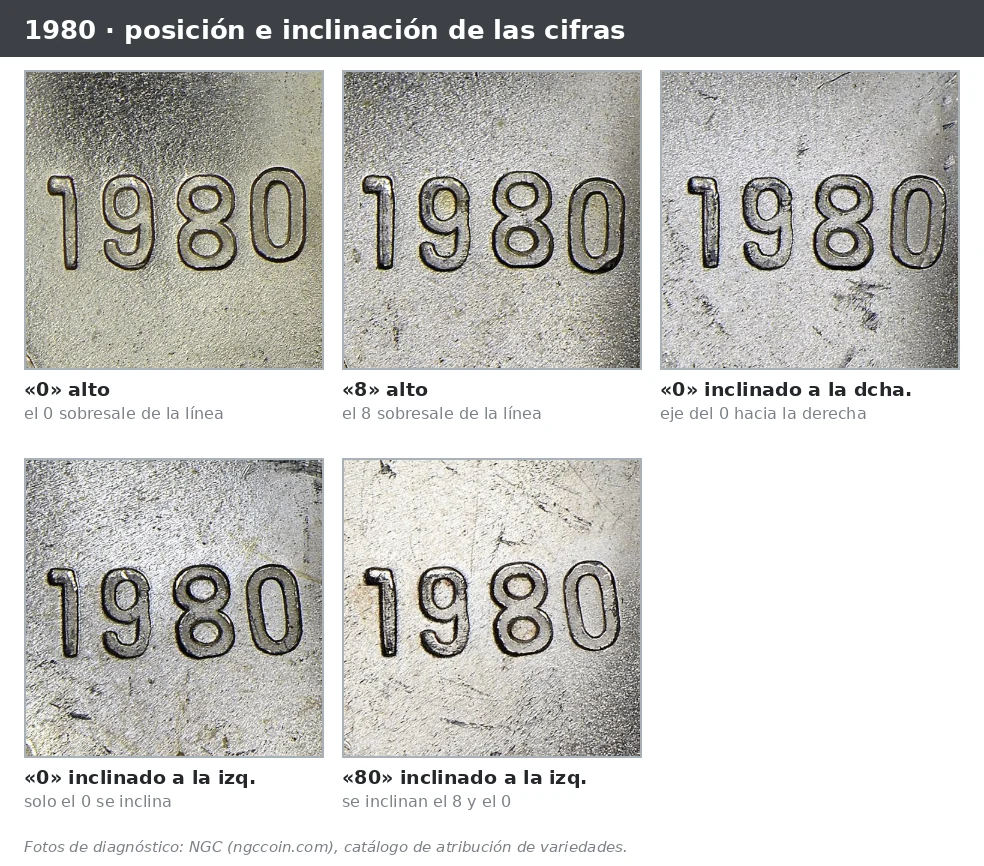
For the position varieties, I draw an imaginary line under the base of the 1 and the 9: the digit that floats above it is the “high” one. For the slant varieties, I compare the axis of the 8 and the 0 with the vertical stroke of the 1.
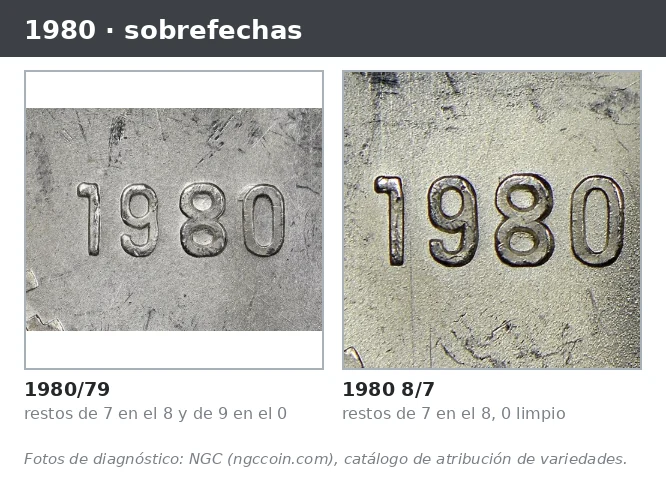
On overdates I always check the last two digits: traces of a 7 in the 8 and of a 9 in the 0 indicate 1980/79; traces of a 7 in the 8 with a clean 0 indicate 8/7.
Doll pinpoints where to look. On the 8 over 7, the top horizontal bar of the 7 can just be made out crossing the top of the 8 and its upper inner curve; it is very faint and often only visible with a loupe on the coin itself, not in a photo. On the 1980/79, the 9 barely shows in a small area of the upper left outer curve of the 0. Doll also documents a 1980/9 with no trace of a 7 in the 8, with a small or large overdate area depending on the die.
Watch the naming: Doll calls his 8-over-7 example “1980/70”, whereas NGC separates the 8/7 (47 coins) from the 1980/70 (13). It is not clear they refer to the same thing, so always go by the grading company's label.
I have not included photos of the 8/8 and 1980/70 varieties, which have no images in the listings consulted.
12. What NGC and PCGS do not recognise: the balance beam and the shifted 9
Two 1979 classifications that neither NGC nor PCGS recognises circulate in videos, listings and forums: the pattern of the balance beam (B1 to B5) and the shifted position of the last 9. I include them so readers know what they are, but my view is clear: they do not justify any premium.
The standard study of the series, by Scott Doll, does not mention them either. It covers Types 1 to 5, the dot before the date and the 1980 date varieties, and warns that its list is not exhaustive. But neither the beam patterns nor a shifted 9 appear in it.
The B1-B5 beam patterns
Some collectors classify the horizontal beam of the balance by its texture. I have not been able to trace the work this naming comes from, so I present it as a community classification.
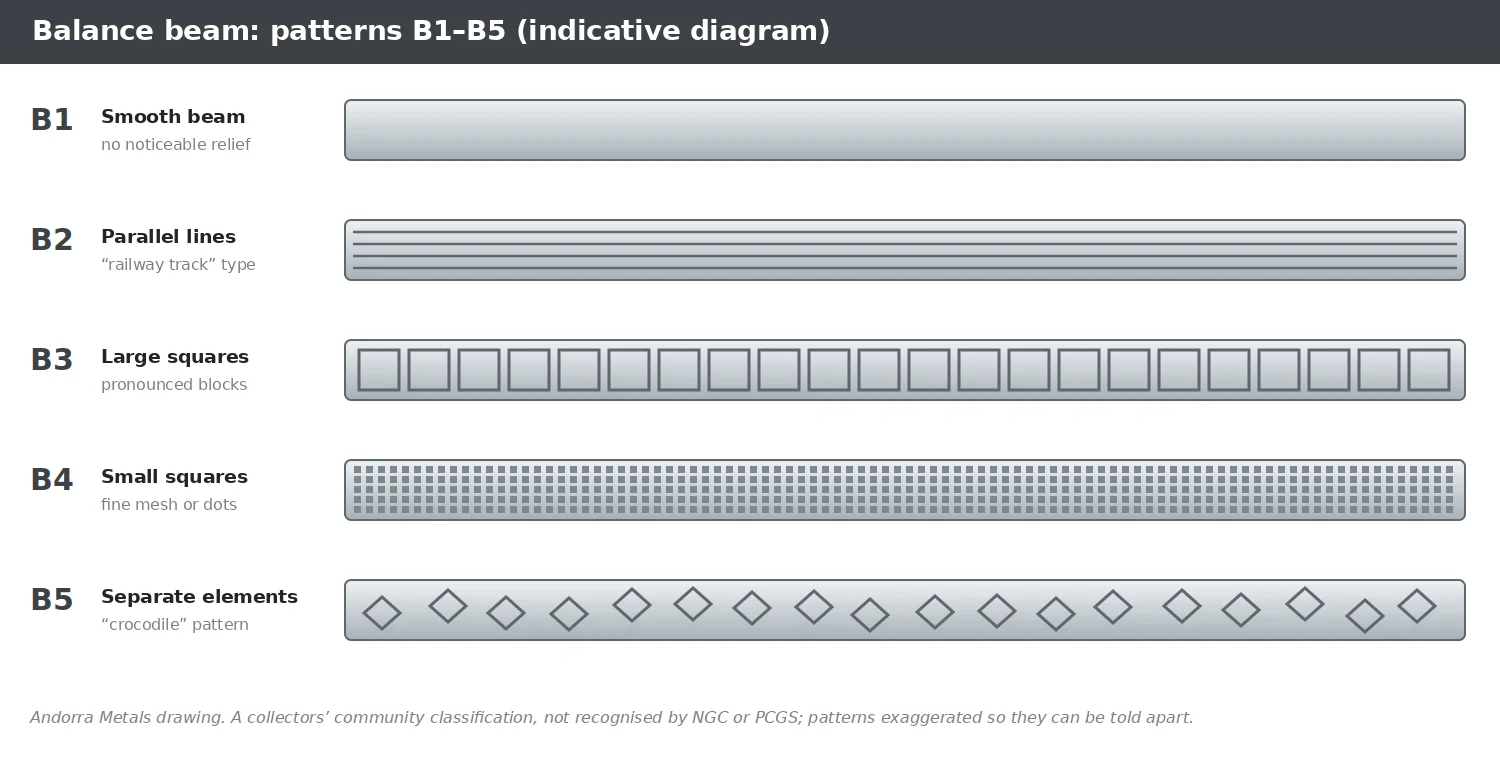
| Pattern | Appearance |
|---|---|
| B1 | Smooth beam, no noticeable relief |
| B2 | Continuous parallel lines, “railway track” type |
| B3 | Large, pronounced squares or blocks |
| B4 | Very small squares, dots or fine mesh |
| B5 | Separate, irregular elements, the so-called “crocodile” pattern |
Differences in texture may come from different dies, but also from die wear or striking pressure. As long as no grading company lists them, the beam pattern is recorded as an observation, never as a variety.
The shifted last 9
Two different things should not be confused:
- 1979/9 (repunched date): a second outline of the 9 is visible. NGC does recognise it, on both the Type 3 and the Type 4 (sections 10 and 11).
- Shifted 9: the last 9 appears higher, lower, tilted or set apart from the “197”, with no double outline. NGC and PCGS do not recognise it.
A 9 that looks out of place can have several causes: a digit punched by hand in a different position on the die, machine doubling or wear creating a stepped edge, or a later knock that distorts the digit. The decisive test is repetition: if the same shift, with the same marks around the date, appears on several coins, it points to a die feature. If each coin shows a different distortion, it is knocks or wear.
Nor is there any documentary basis for the supposed 1979/8 overdate that appears in some listings. I would not use it as a name.
How to describe them in the shop
The main classification is always the recognised one: Type 3 or Type 4 and, where applicable, 1979/9 or dot before the date. Everything else goes separately, as an observation. An honest sales description would be:
Mexico Onza Troy 1979, Type 3. Last 9 apparently shifted; feature not recognised by NGC or PCGS. Sold at the price of a normal Type 3. See macro photographs.
That way the coin can appeal to a curious collector without promising a rarity no catalogue supports.
Conclusion
In 41 mm, the Balanza onza sums up the history of the troy ounce, four centuries of the Mexico City Mint and the birth of the silver savings coin. For the investor it is an ounce of fine silver with a story; for the collector, a short series with five clear types and a handful of varieties that call for a sharp eye and patience.
Sources
- Wikipedia — Troy weight · Ounce · Grain (unit) · Pennyweight · International yard and pound
- Wikipedia — Casa de Moneda de México
- Banxico — Herencia Numismática de México
- Banxico Educa — Historia de la moneda y del billete en México
- Scott Doll, “Study of Mexico's Pre-Libertad Silver Onzas (1949, 1978-1980)”, USMEX Journal, June 2014 — online version · USMEX library
- Numista — 1 Onza, Mexico 1978-1980 · 1 Onza (Pattern)
- El Dato Numismático — Las Onzas Troy en México y la del Capricho
- El Dato Numismático — La medalla Columnaria/Prensa de Volante
- El Dato Numismático — Labores internas de la Casa de Moneda
- Morton Subastas — Onzas Troy de Plata
- PCGS — The Mexican Silver Onza Troy (1949-1980) · PCGS Population Report, Token and Medallic Coinage (checked on 29-09-2026)
- NGC Census — Mexico 1905 To Date, 1 Onza (checked on 30-09-2026) and NGC variety attribution catalogue (diagnostic photos)
- El Universal Puebla — Cuánto vale hoy una Onza Troy
- Grace's Guide — De Grave, Short and Co · Science Museum Group — Assay balance