Physical or paper: what happens to gold and silver when the market collapses
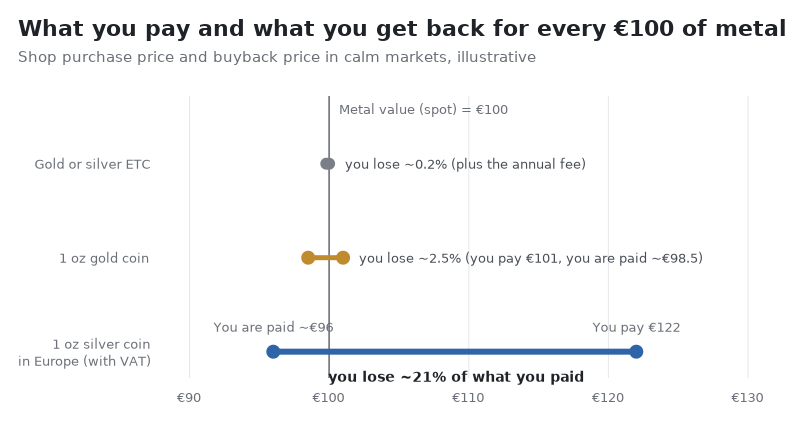
Physical gold and silver do not go their own way: they are worth spot plus a premium, and in 2026 they moved with spot. From January's high to today, the shop price of the Krugerrand has fallen around one point less than quoted gold, and that of the silver Maple around two points less. But that small advantage is enjoyed by whoever is selling the coin, not by whoever holds it: the premium props up the price the dealer sells at, not the price it buys back from you at. Anyone who bought physical silver at the late-January peak has lost more than someone who bought paper, because they paid a premium they are not getting back. In a normal fall, the real advantage of physical is not in the price but in behaviour. In a full-blown crisis, of the system or of supply, an advantage in price and in access does appear. In 2008 and in March 2020 physical decoupled from paper on the upside and there were dealers buying back above spot, and in 2026 there were paper-gold platforms that froze withdrawals. With no screen, no margin calls, no counterparty and a certain amount of friction to selling, the holder of coins and bars does not usually sell at the worst moment. The 2026 data support this, though with important caveats, and no study directly compares the returns actually earned by each group. In gold that protection comes cheap (a full round trip costs 1.5–3% in calm markets). In silver, with European VAT, it costs more than 20%, and it only pays off over a horizon of several years.
Download the report as PDF (Spanish)
In 2026 physical tracked spot, with two weeks of divergence in silver
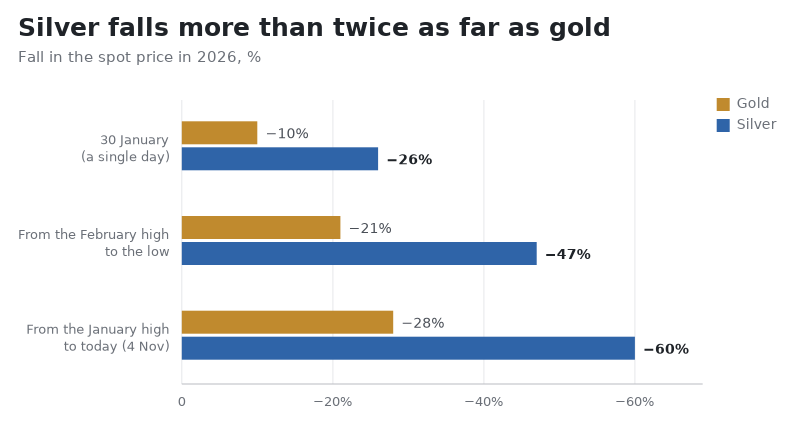
The year has been a stress test like few others. Gold set its record at around USD 5,595 on 29 January 2026 and the next day fell between 9.5% and 10%, its worst session since the early eighties (investingLive; Irish Times/Reuters). Silver, which had touched around USD 121, lost more than 25% in a single day: −26% in spot and −31% in the Comex future, the biggest fall since March 1980 (MarketWatch via Tiger). Over six sessions it racked up as much as −47%, and gold −21% over two (gold.de). Silver's implied volatility went above 80, the highest since 2013 (Pulse.bot). Then came a monthly fall of close to 14% in March and another of 12% in June (The Peninsula/Reuters; Angel One/Reuters). October closed with a fall of around 6–7% in gold, the worst October since 2008, with lows near USD 3,880–3,900 on the 30th, and with silver at around USD 49 (XTB; our silver and gold premium studies). Today, 4 November, gold is at around USD 4,040 and silver is hovering around USD 49.
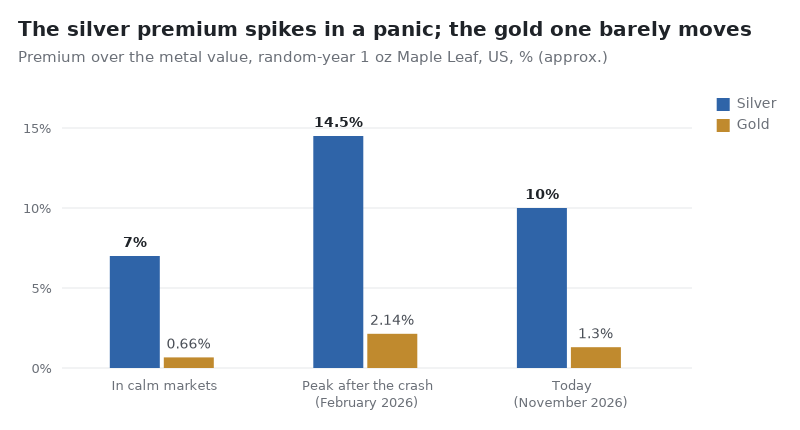
And physical? In our data the answer is clear-cut. In gold, the premium on a 1 oz random-year coin moved between 0.3% and 3% across the whole period. After the crash, the Krugerrand's rose to 0.9% and the Maple's to 2.14%, and both returned to their normal band within one to three months (our gold premium study). When spot falls 10%, a premium going from 0.5% to 1.5% does not change the story. In silver there was a divergence, but a brief one. The lowest premiums on 1 oz coins jumped to 19–34% in the US between 2 and 20 February, and random-year premiums came back to 5–9% within two to five months (our silver premium study). In May, with the wave of buybacks, there were bars at spot and Silver Eagles below spot. According to FindBullionPrices, US Mint sales of Silver Eagles to its authorised dealers were zero that month (FindBullionPrices). That is the Mint's wholesale channel, not the whole market, but it indicates that dealers had plenty of product coming in from buybacks. Physical separated from paper for a few weeks and then converged again. There was no permanent “decoupling”.
| Indicator (2026) | Spot gold | Physical gold (1 oz coin) | Spot silver | Physical silver (1 oz coin) |
|---|---|---|---|---|
| Fall on 30 January | −9.5% to −10% | Same as spot, give or take the premium | −26% spot (−31% Comex) | Same as spot; the premium jumped days later |
| Peak to February low | Up to −21% | Same | Up to −41% / −47% | Same |
| From the January peak to today | Around −28% | Shop price fell ~1 point less | Around −60% | Shop price fell ~2 points less |
| Premium in calm markets | — | 0.3–1.3% (US); ~0.6% (Europe) | — | 5–8% (US); 19–25% with VAT (Europe) |
| Premium after the crash | — | 0.9–2.9% | — | 19–34% lowest (US); ~40% average (Germany) |
| Buyback under stress | — | Spread of ~7% in Germany (March) | — | 8% to 18% below spot at US dealers (January); ~38% spread in Germany |
| Return to normal | — | 1–3 months | — | 2–5 months (random-year) |
Sources: our silver and gold premium studies; Kettner Edelmetalle; Bitcoin.com News; Saxo.
Where there were large and damaging divergences was in local Asian premiums. But those premiums almost always worked against the buyer. Silver in Shanghai traded more than 30% above London at the peak and fell to less than 10% days after the crash (Saxo). Anyone who bought at the top suffered two falls at once: spot and the premium.
The premium cushions the shop price, not your buyback
This is the most widespread illusion. If you look at a dealer's price tag, physical looks as though it has fallen less, because the premium in percentage terms rises when spot falls. But that tag is the price at which the dealer sells. What matters to the holder is the price at which the dealer buys, which on bullion coins is at spot or a little below. The premium you paid on purchase is a sunk cost: nobody gives it back to you when you sell.
Let us do the sums for someone who bought at the high of 29 January. These are approximate figures, with buyback at metal price or slightly below:
| Purchase at the peak (29 Jan 2026) | Approx. price paid | Approx. buyback value today | Loss for the holder |
|---|---|---|---|
| Paper silver (spot/ETC) | ~USD 121/oz | ~USD 49 | ~−60% |
| Silver Maple in the US (premium ~7%) | ~USD 129 | ~USD 48 | ~−63% |
| Silver Maple in Europe (premium ~19%, VAT included) | ~USD 144 | ~USD 48 | ~−67% |
| Paper gold | ~USD 5,595/oz | ~USD 4,040 | ~−28% |
| Krugerrand (premium ~0.5%) | ~USD 5,620 | ~USD 4,000 | ~−29% |
Our own calculation based on our silver and gold premium studies. It is illustrative: exact prices depend on the dealer and on the day.
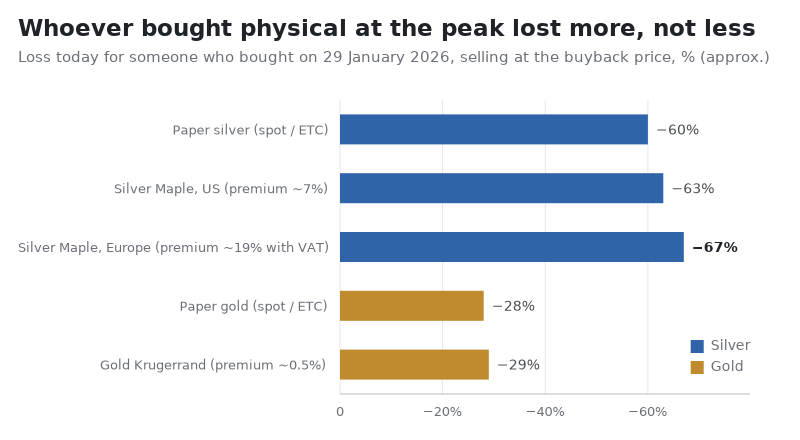
In gold the difference is one or two points. In European silver it is seven points of extra loss, which is exactly the VAT and the margin paid on purchase. The same thing happens, taken to the extreme, with semi-numismatic coins. The average price of the silver Libertad in the US is still anchored at around USD 93 with silver at 49, a premium of close to 90% (our silver premium study). That protects the holder on paper only. If you sell to a dealer who pays for metal, you get what the metal is worth. And the secondary market does not usually pay premiums that are not backed by real scarcity. As specialists in Mexican coinage, we love the Libertad, but we do not sell it as a shield against falls.
What is more, in moments of stress silver buyback gets worse. On 24 January, with silver at around USD 103, none of the US dealers surveyed was paying more than 92% of spot. Some had stopped buying bars and generic silver (Bitcoin.com News). In February some dealers suspended purchases of 90% silver, and refiners, overwhelmed, limited intake or cut prices (The Alloy Market; FindBullionPrices). In Germany, at the end of March, the 1 oz silver coin was trading at a premium of around 40% and a resale spread of close to 38%. In gold, that spread was around 7% (Kettner Edelmetalle). In high-mintage gold we found no buyback suspensions. In silver, the risk in a crash is above all one of exit liquidity.
When the crisis is total, physical decouples from paper
So far we have been talking about price crashes: the market sells, the buying premium rises and buyback does not improve. But there is another kind of crisis, one of system and supply, in which plants, mints, platforms and banks stop working normally. In those crises physical does separate from paper, and this time in favour of whoever has it in hand. The difference is what is missing: if there is metal to spare and no buyer, the decoupling hurts the seller; if metal is scarce, the dealer needs to buy back and pays above spot.
2008. After Lehman collapsed, in December 2008 Silver Eagles were selling in eBay auctions at average premiums above 100% over a spot of around USD 10, and some dealers were paying a dollar or more above spot to buy back (Market Oracle, December 2008). It is a single source from the time, and an auction one at that, so we take it as indicative rather than as a market average. But it points in the same direction as 2020: paper was setting a price and whoever had coins could sell them for more.
March 2020. In the pandemic panic, silver futures were around USD 13, but most coins and small bars cost USD 19–20. The Canadian Mint shut down, the US one suspended Eagle orders and almost all product under 100 oz sold out. Dealers raised their buyback prices sharply to attract sellers (Money Metals; FXStreet). At the same time the PSLV silver trust, which is paper backed by metal, was trading at a discount of more than 10% to its value (FXStreet). The same metal was worth less inside a listed vehicle than in a coin. And the Silver Eagle premium stayed at USD 9–12 for months after spot had recovered (Greysheet).
January and February 2026. The crash had a bit of both. In the West it was a price crash: silver buyback got worse, as we saw above. But in Asia paper failed in a more serious way. In Shenzhen, unlicensed platforms trading “virtual”, leveraged gold in the Shuibei market blocked customers' access to their money. The problems began before the crash, with gold still rising: Jieworui stopped honouring withdrawals on 19 January, the next day capped them at 500 yuan a day per customer and on the 26th offered to settle with 20% in seven days or 40% in a year. Yundiandang suspended withdrawals on 31 January. The authorities later banned the practice (Caixin). Several Chinese banks dismantled their leveraged products on the Shanghai Gold Exchange (Tiger). A Chinese silver fund went from trading at a 60% premium to four consecutive limit-down sessions, and silver in Shanghai at one point traded more than 30% above London (Saxo). These opaque platforms should not be confused with a regulated ETF or ETC, which have a different legal protection. But the case shows access risk in its purest form. Anyone who had the coin or the bar in their safe did not depend on a platform opening, or on a fund recovering its net asset value.
| Episode | What happened to paper | What happened to physical | For whoever already held it |
|---|---|---|---|
| Dec 2008 (financial crisis) | Silver spot at ~USD 10 | Premiums >100% on Eagles; product scarce | Some dealers were buying back above spot |
| Mar 2020 (pandemic) | Silver futures ~USD 13; PSLV at a >10% discount | Product at USD 19–20; mints closed | Buyback prices rising to attract sellers |
| Jan–Feb 2026 (the West) | Margins raised three times; forced selling | Buying premium 19–34% | Silver buyback worse: 8–18% below spot |
| Jan–Feb 2026 (China and India) | Opaque platforms frozen (from before the crash), products wound up, funds and ETFs with premiums that evaporate | Stayed in its owner's hands | No risk of being locked out |
Sources: those cited in the text. Those for 2008 and 2020 come in part from dealers, with a commercial interest; we treat them as indicative.
The lesson matters, because this is the part of the argument that really is an advantage in price and not only in behaviour. In a supply or system crisis, physical is the only format whose value does not depend on somebody else working: not the broker, nor the clearing house, nor the platform, nor the fund issuer. And if what is scarce is metal in hand, the price you are paid can sit above the spot on the screen for weeks or months. By contrast, in a price crash with a surplus of sellers, like January's in the West, the decoupling works against whoever is selling silver. That is why we talk about physical as insurance: it does not protect you from every fall in price, but it does protect you from the scenario in which paper stops working. In high-mintage gold that insurance comes cheap; in silver it is dearer, but it is precisely silver that decouples most in the real crises.
Where physical really wins: in the investor's head
If physical does not fall less, why do so many people prefer it in a crash? Because investors get far more rattled by losses than by gains, and the format matters. Gneezy, Kapteyn and Potters took Benartzi and Thaler's “myopic loss aversion” into a market experiment. With more information and more flexibility, investors took on less risk. When they saw their result less often and found it harder to change position, they paid significantly higher prices for the risky asset (RAND / Journal of Finance, 2003). A coin in a safe gives you exactly that: no phone valuing it every minute, and a trip to the shop in order to sell it. Morningstar also documents that the more volatile a fund is, the more the average investor loses relative to the fund itself by getting in and out at the wrong time. In the most volatile quintile of sector funds, that gap exceeds 7 points a year (Morningstar, Mind the Gap 2024). Note: the study expressly excludes commodities.
The second advantage is not psychological but mechanical: nobody can force you to sell a coin. After 30 January, the CME raised margins on COMEX gold and silver futures three times in a week; from 6 February it required 9% of contract value in gold and 18% in silver (Kitco/Reuters). The forced liquidations had a “cascade effect” (Irish Times/Reuters). The rebalancing of the leveraged ETF AGQ alone forced the sale of around USD 4 billion in silver futures (Saxo). In October the story repeated itself through another channel. Margin calls caused by the fall in tech stocks forced the sale of liquid assets, gold included (XTB). In CFDs, the European rule closes the position when margin falls to 50% of that required. According to the national regulators, between 74% and 89% of retail CFD accounts lose money (ESMA).
The data on physical holders fit this idea. According to the 2026 Reisebank/Steinbeis study, 87% of German gold owners sold nothing in the last twelve months, in a year of records and crashes (gold.de). At the largest German price comparison site, enquiries were 94% buying in June and 93% in September (Börse Online; gold.de Insights), and, as we recorded in our gold premium study, around 95% in October. In China, October's fall below USD 4,000 filled the aisles of the Shuibei market with buyers (Business Today). And in 2013, the clearest precedent, ETFs sold 402 tonnes in a quarter while bars and coins set a record of 507.6 tonnes (Mining Weekly).
Now the other side, which we do not want to hide. Unleveraged paper did not panic in January. Gold ETFs took in USD 19 billion that month, a record (WGC). A monthly figure does not prove that those inflows arrived during the fall, because part of it may have come in during the previous rally, but it does rule out a mass exodus. In the third quarter another USD 31 billion came in with the price falling (WGC). The big outflow came in March, USD 12 billion, concentrated in North America and in order to raise cash (NewKerala/WGC). Physical sells too, though it tends to do so on the way up. Reisebank's customers sold more to the bank than they bought in the first quarter (Börse Online). The WGC reports high levels of resale in Europe and profit-taking in Australia (WGC). On BullionVault, silver holders were net sellers of 25.8 tonnes in January (Cash-online). And there were queues of sellers in the Dubai souk on 29 and 30 January (Khaleej Times).
Nor did physical protect anyone who bought expensively in Asia. The Korean gold premium reached 18.55% in October 2025 and halved in a week (Bloomingbit). The Vietnamese SJC gold premium halved between March and May 2026 (VietNamNet). In India, some silver ETFs traded at a premium of more than 12%. When the premium vanished, they fell as much as 24% in a day while their net asset value fell by around 6% (BasuNivesh). In the interests of intellectual honesty: the data we have are flows, intentions and surveys. There is no study comparing the returns actually earned by holders of physical gold with those earned by ETF investors. And there are two serious objections. The first is selection: perhaps the patient investor is the one who chooses physical, rather than physical being what makes him patient. The second is that friction cuts both ways: it holds back the impulsive sale, but it can also hold back a necessary rebalancing. That discipline, moreover, has to make up for the premium, the storage and the buyback spread. Our thesis is reasonable and the evidence supports it, but it is not proven.
Gold and silver are not playing the same game
In gold, the behavioural protection of physical comes cheap. A high-mintage 1 oz coin can be bought in Europe at a premium of around 0.6%, VAT-free in the EU as investment gold. With a good dealer, the full round trip (premium plus buyback discount) is around 1.5–3% in calm markets. In stressed phases it can rise towards 7% (our gold premium study; Kettner Edelmetalle). Between buyers there are enormous differences. Stiftung Warentest found €238 of difference between the best and the worst offer for the same Krugerrand. Against an ETC at 0.12% a year (EU Personal Finance), physical is dearer over one year, but over five or ten years the difference washes out. In exchange, you remove the counterparty and the sell button.
In silver, VAT changes everything. In Spain silver pays 21% VAT and investment gold is exempt (Funds Society). A Maple costs around 19% over metal at a European dealer, and the full round trip exceeds 20% (our silver premium study). Silver has to rise by that much just to break even. With that toll, physical silver only pays off over a horizon of several years. For a tactical position, of weeks or months, a physical silver ETC at 0.20% a year is far more efficient. If what you want is to decide how much silver to hold against gold, we go into it in why combine silver and gold.
| Vehicle | Typical cost | Counterparty | Margin / forced sale | Liquidity in a crisis | Basic tax treatment (Spain, indicative) |
|---|---|---|---|---|---|
| Physical gold in hand (coin/bar) | Round trip 1.5–3% in calm markets; own storage | None | No | Buyback available; wider spread under stress | VAT-exempt; gain taxed in the savings base |
| Physical silver | Round trip >20% (21% VAT) | None | No | The worst in a panic: limited buybacks, refiners overwhelmed | 21% VAT; gain taxed in the savings base |
| Allocated vaulted account | 0.12% gold / 0.48% silver a year (BullionVault) | Custodian (operational) | No | High, online | Depends on structure and residence |
| Physical ETC/ETF | 0.10–0.40% a year | Issuer and custodian (the ETC is debt) | No, unless bought on credit | High, intraday | Capital gain |
| Closed-end fund (PSLV) | 0.45% a year | The fund | No | Can trade at a discount: −20% in a month in March (24/7 Wall St) | Depends on the country |
| Futures | Commissions and roll cost | Clearing house and broker | Yes: margins of 9% (gold) and 18% (silver) in February | High, but with forced liquidations | Capital gain |
| CFD | Daily funding: cost of carry + 3% a year (IG) | The broker itself | Yes: automatic close-out at 50% of margin | High, until they close you out | Capital gain |
| Unallocated account / OMS / platforms | Spreads of several % | Bank or platform (unsecured creditor) | Depends on the product | Default risk: Shuibei platforms capped withdrawals at 500 yuan a day (Caixin) | Depends on the country |
| Tokens (PAXG, XAUT) | Redemption fees 0.5–2%; physical delivery from a 400 oz bar (DeFiPrime) | Issuer and custodian; different supervision | No, unless leverage is used | High in crypto; can drift from spot | Depends on the country; consult an adviser |
Tax treatment is indicative and depends on residence: consult your adviser. In the EU, investment gold is VAT-exempt under Directive 2006/112/EC. In Germany, physical gold and Xetra-Gold become tax-free after a year (Kettner Edelmetalle). France applies 11.5% on the sale price or 36.2% on the gain, with a reduction for years of holding (JeChange).
On Andorra, our gold premium study records a super-reduced IGI rate for investment gold, and the silver one the general rate of 4.5%. In both cases it is worth confirming this with the shop and with an Andorran adviser before each transaction. And buying in Andorra does not avoid import VAT if the silver is taken into the EU.
What the forums say on each continent
A word on method. Many forums (r/Silverbugs, Kitco, burbuja.info, Forocoches, Xueqiu, Ekşi Sözlük, banki.ru and silverstackers, among others) could not be consulted directly. What follows combines accessible threads with the press coverage of those communities. It should be read as a gauge of opinion, not as statistics.
North America: “paper is manipulated”, but physical sold below its metal
On Reddit, the dominant reading after 30 January was that the crash was a paper-market phenomenon. The blame went to the Comex margin hikes, to JPMorgan's role as SLV custodian or to the Chinese limits, and many saw it as a buying opportunity (r/wallstreetbets). On the more sceptical Collectors Universe, one dealer said that refiners had stopped accepting shipments and that 90% silver was being bought USD 15 to 20 below its melt value. Other posters called it a “flash crash” and rejected the scarcity thesis (Collectors Universe). On the generalist forums the ETF rules: 2–5% in GLD and no messing about with storage and resale (r/investing).
Latin America: the coin at the bank and the CEDEAR
In Mexico, the Centenario and the Onza Libertad are still the popular physical vehicle, bought at a bank branch with wide bid-offer spreads (El CEO). On Rankia Mexico the warning is that financial selling moves faster than physical supply and demand, and that it is unwise to assume the bottom has been reached (Rankia MX). In Argentina, the debate revolves around CEDEARs on GLD and on miners, because the local bar requires proof of funds and was being bought back at around 37% below its selling price (iProfesional). We found no Brazilian or Chilean forums with indexed content.
Europe: taxes before conspiracies
In Germany the conversation is about tax: the one-year holding period that makes gold and Xetra-Gold tax-free, the silver ETCs that are taxed and the 19% VAT on silver (Goldesel; Börse Online). On the French moneyvox forum, one user summed it up as “gold is insurance: it depends what against”. For him, ETCs against financial risk and physical against the extreme scenarios. Others were asking whether gold is still a haven after falling while oil went up (moneyvox). In the United Kingdom the argument is between the gold Britannia, free of capital gains tax, and the silver ETC as a way round VAT (MoneySavingExpert). On Rankia Spain, after the crash, the debate was whether to take profits in silver ETCs (Rankia).
Asia: local premiums, platforms that do not pay and queues to buy
In China, the “paper” that failed was not the ETFs but unlicensed Shuibei platforms operating with virtual balances. When they could not pay, they offered to settle with 20% (Caixin). The banks, meanwhile, stopped intermediating leveraged products (itiger). According to one internet user quoted in the press, in Shuibei there were “more people buying gold than at a vegetable market” (Business Today). In India, the regulator warned that the “digital gold” sold through apps falls outside its protection (Business Today). In Thailand, on 2 February the dealers' online systems collapsed, and some investors could not sell in time (Nation Thailand).
Middle East, Russia and Turkey: physical out of mistrust, paper for tax reasons
In Dubai, jewellers described the queues of sellers as profit-taking rather than distressed selling. Days later, demand shifted from jewellery to bars and coins (Khaleej Times). In Turkey, where households are estimated to hold almost USD 500 billion in gold, Borsa Istanbul gold certificates traded at one point at a 21% premium to physical (GuruFocus; Daily Sabah). In Russia, non-physical metal accounts (OMS) are growing, as they pay neither VAT nor storage, although they have no deposit guarantee (Vyberu.ru).
Oceania: Australians bought silver in the middle of the fall
Perth Mint's silver sales rose 188% in January against December, while its gold sales fell. Its listed product PMGOLD set record holdings (Perth Mint). On r/fiaustralia, one argument in favour of physical was precisely that it reduces the temptation to sell in a panic. Against it, people cited theft, inheritance and the impossibility of selling half a coin (r/fiaustralia).
Africa: selling grandad's Krugerrand and hedging the currency
In Johannesburg, gold buyers report more heirs and investors reselling Krugerrands at record prices in rand. Note: the source is a promotional release from a buyer (South Africa Today). In Nigeria, the weakness of the naira is pushing first-time buyers towards bars, coins and digital platforms, and experts are warning about fraud and low-purity gold (Zawya).
Physical as the core, paper for tactics and hedging
With all of the above, our view is straightforward. High-mintage physical gold works as a long-term core: it costs little, it has no counterparty and its greatest virtue is that it makes you resist selling on the worst day. Physical silver makes sense for anyone who thinks in years and accepts the European tax toll. For tactical positions, hedges or bets measured in months, unleveraged paper (physical ETCs) is more efficient. Futures and CFDs are professional hedging tools, not a way of saving. And it is wise to distrust any product presented as “physical” without real delivery or identified storage.
What we will never say is that “physical does not fall” or that it is a “guaranteed safe haven”. In June 2026, the British advertising regulator (ASA) censured an advert by Britannia Bullion. The advert omitted that investment in physical gold is not regulated, that it falls outside the compensation schemes and that its value can go down, and the ASA required that warning to appear in the advert itself (FX News Group). US regulators had already warned in 2024 that the “safety” pitch conceals risks and high margins (InvestmentNews). The year 2026, with gold losing more than 20% and silver more than 40% in a matter of days, is the best proof that they are right.
Conclusion
The physical-versus-paper debate is usually framed as a question of price, and 2026 shows that this is the wrong question. It helps to separate four risks. Price risk is the same for both: a coin in the safe does not avoid the loss. Counterparty and custody risk largely disappears with physical in hand, but in exchange you take on theft, authenticity, insurance and storage; professional allocated storage reduces the latter and adds others, such as jurisdiction or segregation. Liquidity risk depends on the product: high-mintage gold is bought back by any dealer, and silver seizes up in a panic. And access risk, not being able to get at the asset even though it exists, is where physical in hand clearly wins in a total crisis. The price is the same; what changes is who holds the decision to sell. In leveraged paper, that decision belongs to the broker, the margin and the algorithm. In an ETC, to your finger and a screen. In a coin, to you, with a trip to the shop in between. That friction is worth money in a year like this one, but it is not free. In gold it costs very little. In European silver it costs enough that it is only worth it with patience.
And there is one scenario in which physical does something that no paper can do: when the crisis is one of the system and not only of price. In 2008, in March 2020 and on the Asian platforms of 2026, paper was left with its screen price, with discounts or with withdrawals frozen, while the coin in hand was still worth its metal, and sometimes more. That is the underlying reason to hold a part of your holding in physical: not to make more in every fall, but to have something that works when everything else stops working.
The practical consequence is not intuitive: the best moment to buy physical is not when the market crashes, because premiums jump in precisely the days after the fall. It is in the calm that arrives weeks later, when the buybacks refill the channel. Anyone who already has the core built does not need to do anything in the panic, and that is precisely the advantage.
If you want to see, at the day's prices, which combination of physical and paper makes sense in your case, book an appointment at Andorra Metals (Carrer Pau Casals, 8, Edifici Cornella II, Andorra la Vella) and we will go through it together. You can run a first simulation with our gold/silver calculator.
This article is for information only and does not constitute personalised investment advice.
Sources
- Capital Vision: Which silver coin to buy: what the 2025–2026 premiums teach us (3 Nov 2026) and Which gold coin to buy: what the 2025–2026 premiums teach us (4 Nov 2026)
- investingLive: Gold extends decline to 10%, silver heads for its worst day ever
- Irish Times/Reuters: Gold and silver extend free fall
- MarketWatch via Tiger Brokers: the 30 January crash
- Saxo: Silver, when a record rally turns into a record rout
- Saxo: Silver remains unsettled
- gold.de: Gold-Crash, der keiner war
- Pulse.bot: Silver volatility spike
- The Peninsula/Reuters: Gold set for worst month in over 17 years
- Angel One/Reuters: Gold falls over 12% in June 2026
- XTB: Gold prices drop sharply at the end of October
- FindBullionPrices: Silver Eagle sales hit zero in May 2026
- FindBullionPrices: Junk silver below melt
- Kettner Edelmetalle: Edelmetallmarkt in Stressphasen
- Kettner Edelmetalle: Xetra-Gold, Lieferanspruch, Steuer, Risiken
- Bitcoin.com News: Silver breaks 100 but selling physical isn't simple
- The Alloy Market: dealer spreads
- RAND / Journal of Finance (Gneezy, Kapteyn and Potters, 2003)
- Morningstar: Mind the Gap 2024
- Kitco/Reuters: CME hikes gold, silver margins again
- ESMA: intervention measures on CFDs
- gold.de: Goldstudie 2026 (Reisebank/Steinbeis)
- Börse Online: Deutsche Anleger kaufen den Gold-Dip
- gold.de Insights, 1 Oct 2026
- Börse Online: Reisebank meldet Goldboom
- Mining Weekly: Gold value falls as investors exit ETFs (2013)
- WGC: Gold ETF flows, January 2026
- WGC: Gold ETF flows, September 2026
- WGC: Gold Demand Trends Q2 2026, Investment
- NewKerala (WGC data): Record March outflows
- Cash-online: Käufer dominieren (BullionVault, January 2026)
- Khaleej Times: UAE gold panic selling driven by profit booking
- Khaleej Times: A split-screen Dubai gold market
- Bloomingbit: KRX gold premium
- VietNamNet: Domestic gold premium halves
- BasuNivesh: Gold and silver ETF NAV trap
- Business Today: Record crowds at Shuibei
- Business Today: SEBI cautions against digital gold
- Caixin: Shenzhen cracks down on risky gold trading
- itiger: Chinese banks exit SGE agency trading
- Nation Thailand: Gold Traders Association, 2 Feb 2026
- EU Personal Finance: Best gold and silver ETFs
- BullionVault: tariff
- 24/7 Wall St: PSLV investors get a brutal reminder
- IG: CFD overnight funding
- DeFiPrime: Tokenized metals onchain 2026
- Funds Society: Cómo tributa la inversión en metales preciosos en España
- JeChange: Vendre de l'or, taxe de 11,5%
- r/wallstreetbets (snapshot)
- Collectors Universe: thread after the crash
- r/investing (snapshot)
- r/fiaustralia (snapshot)
- El CEO: Centenario and Onza Libertad prices
- Rankia México: gold and silver fundamentals
- iProfesional: gold bars in Argentina
- Goldesel: Edelmetall-Crash 2026
- Börse Online: Warnung bei Silber-ETCs
- moneyvox: forum Or, ETC ou or physique
- MoneySavingExpert: forum
- Rankia: comments on silver
- GuruFocus: Turkey's digital gold mania
- Daily Sabah: Physical gold gap in Türkiye narrows
- Vyberu.ru: Russians buying gold in OMS accounts
- Perth Mint: January 2026 sales update
- South Africa Today: South Africans selling gold and Krugerrands
- Zawya: Is gold still a safe haven for Nigerians?
- FX News Group: ASA ruling on Britannia Bullion
-
InvestmentNews: Investing in precious metals may not be so safe
-
Market Oracle: Why Investors Pay High Silver Premiums? (December 2008)
- Money Metals: Bullion Market Update: Too Little Supply (23 Mar 2020)
- FXStreet: Pandemonium in precious metals market (23 Mar 2020)
- Greysheet: Why Haven't Silver Premiums Come Down?